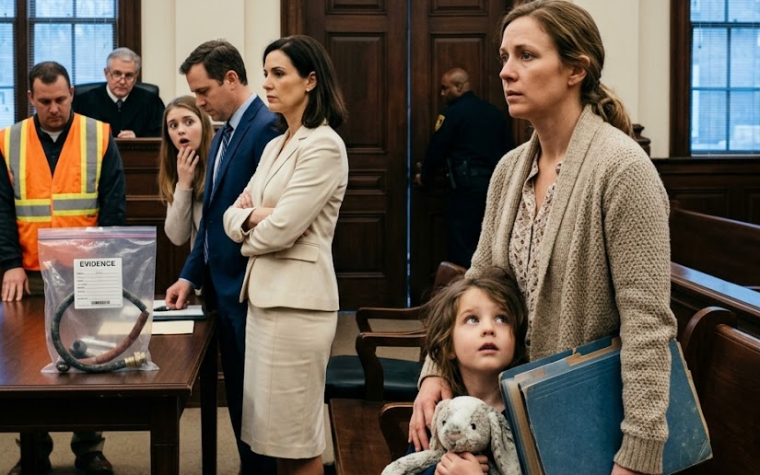
Carter’s funds preserved what was built.
Your actions placed it at risk.”
Brandon turned toward me.
“You’re really going to take the company from your own family?”
I rose slowly.
“I’m not taking it.
I’m stopping you from pretending my part never existed.”
Evelyn began to cry.
They were real tears, but they did not rewrite the ledger.
“Victoria,” she said, “I know I said things.
Mothers say things when they are afraid.”
“You called me a failure when I was paying your employees.”
“I was angry.”
“You called me unstable in a sworn complaint.”
“We thought you were trying to control us.”
“I was trying to see the accounts of a company I owned.”
Her face hardened for a moment, and I saw the familiar version of her return.
“You always needed to prove you were better than Brandon.”
That accusation had controlled me for most of my life.
It was the reason I minimized my work, hid my achievements, and allowed every family dinner to become another trial in which I defended my right to exist quietly.
This time, I did not accept the role.
“I never needed to be better than him,” I said.
“I needed both of you to stop building your confidence out of my silence.”
She looked away.
The company did not collapse after they lost control.
It stabilized.
I kept the drivers, dispatchers, mechanics, and warehouse staff.
None of them had caused the fraud, and I refused to punish employees for the choices of owners.
I hired an outside manager and installed financial controls Brandon had repeatedly rejected.
Within six months, overdue vendor balances were cleared and the company resumed regular profit distributions.
Evelyn and Brandon retained minority interests, but part of their distributions went toward the judgment and repayment order.
Brandon resigned rather than work under independent oversight.
Evelyn moved out of the family home voluntarily after deciding she could no longer afford its expenses.
I did not force her into a tiny apartment.
I helped arrange a smaller house in a safe neighborhood, then asked the property manager to keep my involvement private.
That was not forgiveness.
It was a boundary that allowed me to remain humane without becoming available for destruction again.
Months later, I returned to the Atlanta courthouse to deliver records in another financial case.
Judge Vance passed me in the hallway and nodded.
“Ms.
Carter,” he said.
There was no surprise in his voice that time.
Only recognition.
For most of my life, my family had spoken my name as though it were evidence of disappointment.
In that courthouse, the same name became attached to the truth: the money I had earned, the company I had saved, the work I had done, and the restraint they had mistaken for weakness.
I had not won because the judge remembered me.
I won because, when my mother and brother tried to erase what I had built, I opened the folder and let the record remember for them.