The change in his voice was subtle, but I recognized it.
He no longer sounded like their advocate.
He sounded like a man calculating his own exposure.
Evelyn stood again.
“We thought it had been canceled.”
“By what instrument?” the judge asked.
She hesitated.
“It was understood.”
“An understanding does not cancel a notarized ownership agreement.”
Brandon pushed back his chair.
“She never acted like an owner,” he said.
“She wasn’t there every day.
She didn’t run the trucks.
She didn’t deal with drivers.
She sent money and disappeared.”
I turned toward him.
“I disappeared because you blocked my access after the company became profitable.”
“You left because you couldn’t handle pressure.”
“I was reconstructing your accounts while you were telling employees the company could not afford raises.”
His face changed.
It was only a flicker, but Judge Vance saw it.
“What do you mean by reconstructing the accounts?” the judge asked.
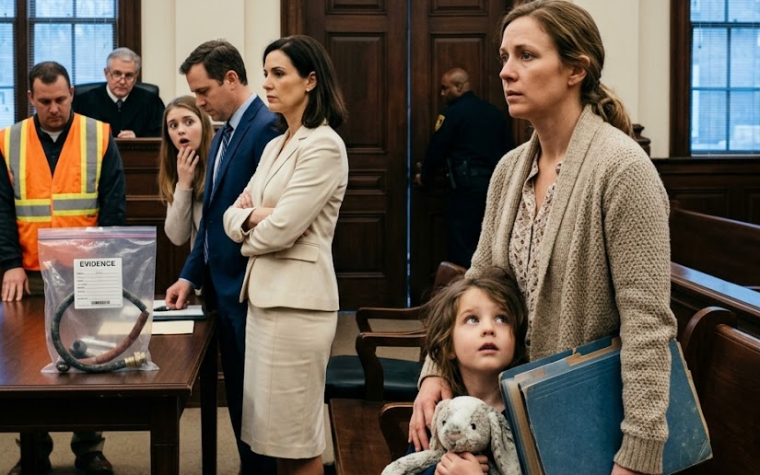
I opened the copy of the agreement I had kept at the podium.
“Paragraph twelve gives me inspection rights and activates an independent review whenever a manager denies the agreement or uses secured funds without consent.
Their lawsuit triggered that provision.”
My mother shook her head.
“She is trying to turn a family disagreement into a criminal accusation.”
“I have made no criminal accusation,” I said.
“I am asking the court to enforce the document all three of us signed.”
Judge Vance studied the agreement for several minutes.
Then he compared it with the exhibits Evelyn and Brandon had submitted.
Their records included a digital copy of the company’s founding ledger.
It showed Brandon as manager and Evelyn as secretary.
The next page jumped directly to the following quarter.
The missing page was the one recording my capital contribution and majority interest.
“Who prepared plaintiffs’ Exhibit Eight?” the judge asked.
Brandon answered too quickly.
“Our accounting office.”
“Which person?”
“I would have to check.”
“Did you review it before swearing it was complete?”
“Yes.”
My mother closed her eyes.
That was his second mistake.
The judge placed the altered exhibit beside the original agreement.
“Mr.
Carter, this court now has a certified instrument showing Ms.
Carter’s ownership, and a company record presented by you that omits the corresponding entry.
You have also testified that you reviewed the exhibit for completeness.”
Brandon’s confidence began to collapse visibly.
He looked at his attorney, but the attorney was writing something and would not meet his eyes.
Judge Vance called a brief recess.
The moment he left the bench, the courtroom filled with whispers.
Evelyn crossed the aisle toward me.
“What do you want?” she demanded.
I closed my folder.