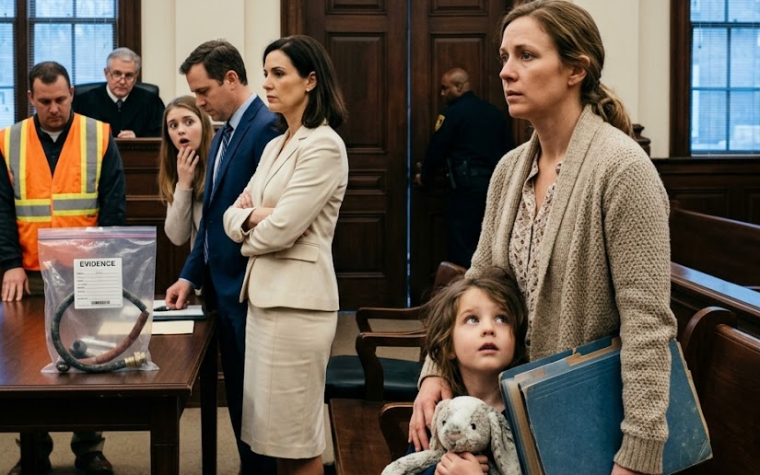
No one moved after Judge Vance asked my mother why she had sworn the document did not exist.
The courtroom seemed to contract around her.
Evelyn’s lips parted, but no answer came.
Brandon leaned toward the bench as though distance, not disbelief, was keeping him from understanding what the judge held.
I remained at the podium with my hands resting lightly on the wood.
For years, my family had relied on one assumption: if they spoke confidently enough, people would accept their version of me.
I was the confused daughter.
The resentful sister.
The woman who could never finish anything and had returned only because she wanted money.
The sealed agreement in Judge Vance’s hands did not care how often they had repeated those words.
It had signatures.
It had dates.
It had a bank certification.
Most importantly, it had been created before there was anything worth fighting over.
My mother finally stood.
“Your Honor, I have never seen that paper,” she said.
Judge Vance looked at the signature page again.
“This appears to contain your signature.”
“It may look like mine, but Victoria has access to financial documents.
She knows how to reproduce things.”
That was her first mistake.
Not because the accusation hurt me.
I had expected it.
It was a mistake because she made it before the judge finished reading the certification attached to the document.
Judge Vance turned the page.
“The agreement was executed at Peachtree National Bank,” he said.
“Each signature was witnessed by the bank’s vice president, notarized, scanned into the escrow system, and sealed under the institution’s document-retention policy.”
My mother’s face tightened.
Brandon rose beside her.
“There was a draft,” he said quickly.
“Maybe that’s what she found.
We discussed possibilities when the company needed cash, but nothing became final.”
The judge raised one hand.
“Mr.
Carter, sit down unless you are instructed to speak.”
Brandon remained standing for half a second too long.
Then he lowered himself into his chair.
The navy fabric pulled across his shoulders.
I remembered the charge from an Atlanta menswear shop that had appeared in the company ledger six weeks before they filed the lawsuit.
The payment had been coded as warehouse safety equipment.
I had not mentioned it yet.
Judge Vance read the first paragraph aloud.
The agreement identified Carter Freight Solutions, Evelyn Carter, Brandon Carter, and me.
It stated that the company was facing immediate default on its warehouse loan, payroll obligations, and the mortgage cross-collateralized against our family home.
It then listed my contribution: $286,000.
Not a gift.
Not a temporary favor.
A capital investment.
In exchange, I received a sixty percent ownership interest, a secured claim against the house until my contribution was repaid, and the right to demand an independent audit if company funds were used without my written consent.
My mother stared at the bench as though the words had been written in a language she did not understand.
Brandon understood them perfectly.
He looked at me for the first time without smirking.
Three years earlier, Carter Freight Solutions had been close to collapse.
Brandon had expanded too quickly, signing leases for trucks the company could not afford.
Evelyn had guaranteed part of the debt against the house, convinced that one profitable contract would solve everything.
The contract never came.