She also warned everyone that destroying, altering, or concealing potential evidence could create additional problems.
Margaret’s fingers slowly moved away from the handbag clasp.
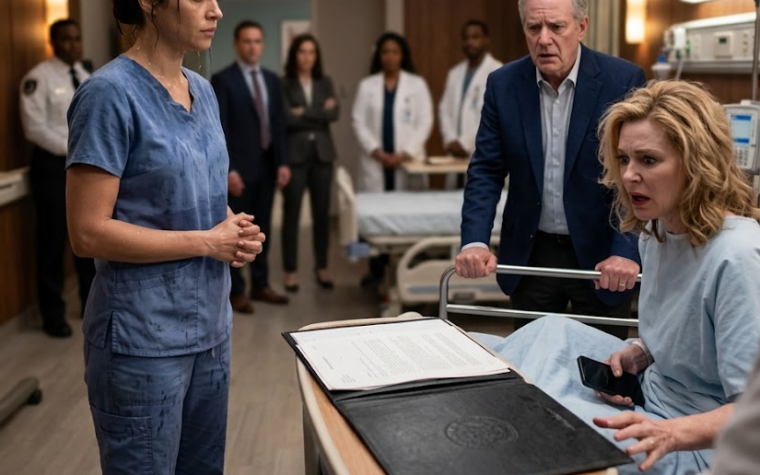
The black folder I carried did not contain secret military files or political favors.
It held something more useful: the notes I had made immediately after Emily’s call, the time the voicemail arrived, the number I contacted at the hospital, and the names of the people with whom I had spoken.
Years in uniform had taught me that panic destroys details.
So before driving to Charlotte, I had saved the voicemail in two secure locations.
I had called emergency services.
I had notified the hospital that Emily might arrive under pressure from people attempting to speak for her.
I had written down every word I could remember.
I had not known the full story.
I had only known that my daughter sounded afraid.
That was enough to begin preserving the truth.
The Prescotts were permitted to leave the hospital only after the police recorded their information and instructed them not to contact Emily.
Margaret walked out first, still holding herself as though photographers were waiting beyond the emergency room doors.
Ethan paused in the corridor.
He looked at Emily through the glass and mouthed, “You will regret this.”
The security camera above him recorded the gesture.
The next morning, investigators obtained authorization to search the guest house and collect evidence connected to Emily’s report.
The room looked very different without the Prescotts controlling the explanation.
A chair had been wedged beneath the exterior door handle.
One of Emily’s earrings lay under the table where she said she had fallen.
A strip of white fabric caught on the edge of a cabinet matched the tear in her dress.
The estate’s electronic access system showed repeated entries by Ethan, Margaret, and Brandon during the hours Emily said she was confined.
The logs also showed that the guest house door had been locked from the outside.
Emily’s missing overnight bag was found in Ethan’s study.
Her identification and bank card were inside it.
Her phone, recovered from Margaret’s handbag, contained messages Ethan had attempted to delete.
Technical recovery revealed fragments of a conversation between the brothers.
Brandon had written that Emily needed to be kept away from neighbors until she “calmed down.” Ethan replied that his mother would prepare a statement and make Emily sign it.
They had not planned to injure her badly enough to leave visible evidence.
They had planned something quieter.
They intended to frighten her, discredit her, and return her to the marriage under conditions they controlled.
When that failed, they followed her to the hospital and tried to finish the job with status and threats.
Within two days, the Prescotts began attacking Emily’s reputation through carefully worded statements.
They did not identify her by name, but people close to the family were told that Ethan’s wife had suffered a private emotional crisis and that the family was protecting her from embarrassment.
Margaret contacted members of the hospital’s governing network and complained that staff had mishandled a delicate domestic matter.
Ethan accused me of using my rank to intimidate civilians.
I answered none of it publicly.
Every message was saved.
Every call was logged.
Every attempt to pressure Emily became another piece of the pattern.
My uniform did not give me authority over the civilian investigation, and I never pretended it did.
The power the Prescotts feared was not my rank.
It was procedure.
It was documentation.
It was a frightened woman who had finally decided to speak while other people were listening.
Emily was discharged into my care with her arm supported in a sling.
We left through a private exit because reporters had begun gathering near the main entrance.
In the car, she stared through the window for several minutes.
“Did I ruin everything?” she asked.
I pulled into an empty parking area and stopped.
“You did not ruin your marriage,” I told her.
“You exposed what it had become.”
She looked down at the hospital bracelet around her wrist.
“They are going to tell everyone I am unstable.”
“They will try.”