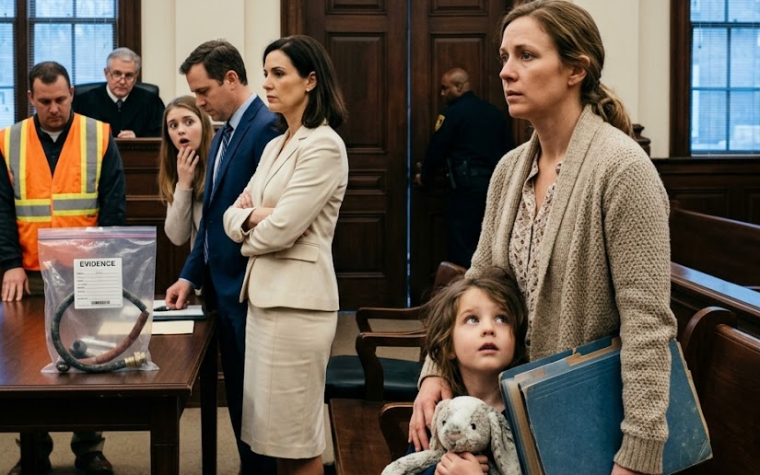
The officer opened the black notebook and read the first page twice.
My mother watched his eyes move down the paper.
Her face changed before he said a word.
The grief she had performed on my aunt’s porch disappeared, leaving behind the hard expression I knew from home—the one that appeared whenever I made her look bad.
“What is that?” the second officer asked.
The taller officer turned the notebook slightly away from my mother.
“A record.”
“It’s nonsense,” she said quickly.
“She writes stories when she’s upset.”
I almost laughed, but my throat was too tight.
There were no stories in that notebook.
The first page began with a date from three years earlier.
Under it, in my uneven thirteen-year-old handwriting, I had listed what time the baby drank a bottle, which child had a fever, how much medicine I gave, and when my mother finally returned home.
The next page contained a grocery list and a reminder to wash two school uniforms before morning.
After that came hundreds of ordinary emergencies that had become my childhood.
The officer turned another page.
“Why is she documenting the children’s medication?” he asked.
My mother folded her arms over her stomach.
“Because she likes to be dramatic.
I ask her to help sometimes.
Every family has chores.”
The officer looked at me.
“How often is sometimes?”
My mouth opened, but no sound came out.
For years, I had been warned never to discuss our home with teachers, neighbors, or relatives.
My mother called it loyalty.
She said families handled problems privately.
She said people who talked caused trouble for everyone.
My aunt touched the middle of my back.
That small pressure reminded me that I was no longer standing in our kitchen.
My mother could not send the younger children into the room to make me feel guilty.
She could not take my phone or stand between me and the door.
“Every day,” I said.
My mother scoffed.
“That’s a lie.”
I kept looking at the officer.
“I make breakfast.
I get them dressed.
I take the younger ones to school.
I stay home when someone is sick.
I make dinner.
I bathe the little ones and put them to bed.”
“She helps,” my mother interrupted.
“She is making it sound like I do nothing.”
The officer raised one hand, stopping her.
I had never seen an adult stop my mother from talking over me.
“What happens when the baby cries at night?” he asked.
“I get up.”
“Who takes the children to medical appointments?”
“Usually me.”
“You’re sixteen.
How do you take them?”
“Bus.
Sometimes we walk.”
My mother’s voice sharpened.
“I’m pregnant.