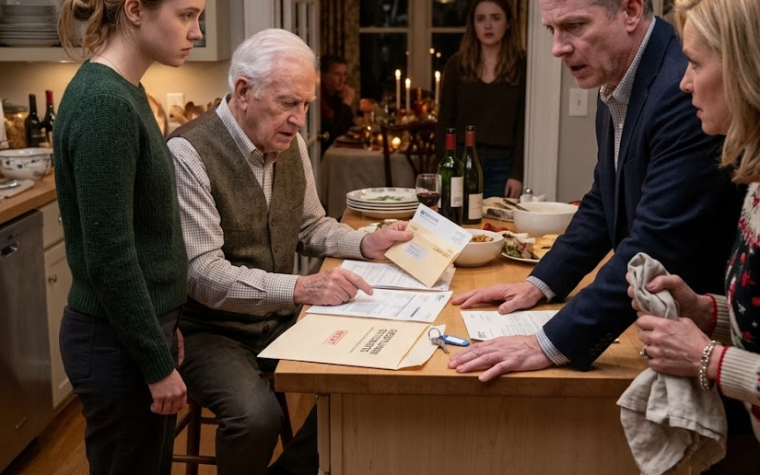
She should have had that from her family.
Instead, she got it from a caregiver who brought her tea.”
He left without another word.
The legal process did not end that day.
Gloria’s nephew challenged the trust and claimed that she lacked capacity.
Her lawyer responded with medical evaluations, witness statements, dated recordings, and the documents Gloria had preserved.
The two nurses who attended our wedding testified that Gloria understood the ceremony and explained her reasons clearly.
The nursing home’s records showed how rarely her nephew had visited.
Bank specialists traced multiple unauthorized transfers.
The attempted property transaction was connected to a company under his control.
Faced with the evidence, his challenge to the trust was dismissed.
The financial investigation continued separately.
Months later, he entered a legal agreement requiring restitution, and the recovered funds were returned to Gloria’s estate before being transferred into the trust.
I was never asked to testify about secret promises because there had been none.
Gloria had never told me she owned a house.
She had never mentioned the trust.
She had never offered me money.
All she had asked was that I sit beside her, listen, and give her one final memory in which she was not alone.
The trust eventually converted Gloria’s small house into a daytime support center for elderly residents without active family.
Volunteers helped with appointments, paperwork, and simple companionship.
A lawyer visited twice each month to answer questions privately.
We created a tea room near the front window.
Gloria would have liked that.
I remained at the nursing home.
I did not become wealthy, and I did not want to.
The trust paid me only for documented work approved by the other trustees.
What changed was the way I looked at every resident who guarded an old bag, repeated the same question, or stared too long at the entrance.
Sometimes stubbornness was not confusion.
Sometimes it was survival.
I kept Gloria’s wedding ring in a small box beside her letter.
Her tea set went into the support center, where one cup remained on the shelf with a hairline crack along its handle.
The old hospital bag stayed with me.
For years, Gloria had held it because she believed it contained the only proof of who she really was.
In the end, the documents did more than expose stolen money.
They proved that she had remained observant, deliberate, and fiercely in control of her final decisions.
People had treated her loneliness as weakness.
Gloria turned it into evidence.
People had assumed an elderly woman could be pressured into silence.
She recorded every threat.
Her nephew believed she had no one.
She chose someone who had never asked what she owned, never tried to open her bag, and never needed an inheritance to stay beside her.
Three days was not long enough to become the husband she might have imagined when she was young.
But it was long enough to fulfill the promise that mattered.
When Gloria left this world, she did not leave as an abandoned woman whose family controlled her story.
She left with her choices intact, her truth protected, and someone holding her hand who believed every word she said.