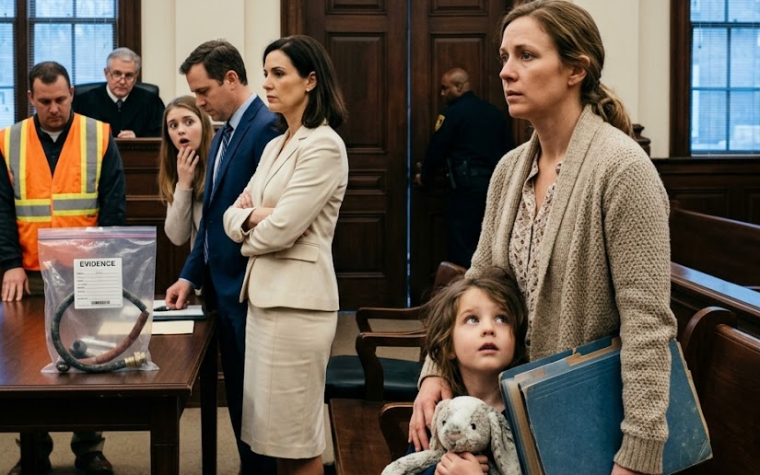
“She kept calling people at all hours.”
“Which people?”
“Neighbors.
Banks.
Anyone who would listen.”
Mom looked at me.
“I called the bank after I saw money missing from my checking account.”
Clara’s chair scraped backward.
“No money was missing.
She misunderstood a transfer.”
I removed the bank statements from the file.
The first set covered the six months before my deployment.
Mom’s pension and savings accounts were stable.
The second set showed what happened after I left: repeated online transfers into a household account Clara controlled, followed by payments to accounts Mom did not recognize.
The amounts were small at first.
Nine hundred dollars.
Twelve hundred.
Eighteen hundred.
Then the withdrawals grew.
Clara shook her head before the doctor had finished reading.
“Those were household expenses.
Margaret lives with us.
Food, utilities, medical appointments—those things cost money.”
“The house belongs to her,” I said.
“There is no mortgage.
Her pension already covers the utilities, and her insurance paid for the two appointments she attended.”
Clara looked at me as though I had betrayed her.
“You checked all of that overnight?”
“I used to investigate financial fraud for the attorney general.”
Her face emptied.
During our marriage, Clara had always treated that part of my life as boring office work.
She remembered the late hours and stiff suits, but not the training.
She had never asked how we traced hidden transfers, preserved digital evidence, or identified documents created to make theft look like consent.
The doctor continued through the file.
He found the email-routing changes that sent Mom’s bank statements to Clara’s private address.
He found the pending request to wire eighty thousand dollars from Mom’s savings account.
He found the access history showing that the request had been initiated from Clara’s laptop two days before I returned.
“This transfer was not completed,” he said.
“It was for professional care,” Clara replied quickly.
“A private memory facility required a deposit.”
“Which facility?”
“I don’t have the information with me.”
“You brought seventeen pages describing Margaret’s supposed symptoms,” the doctor said.
“But you did not bring the name of the facility receiving eighty thousand dollars?”
Clara’s mouth tightened.
“I did not expect to be interrogated.”
“Neither did my mother,” I said.
Mom reached into the pocket of her cardigan and placed a folded piece of paper on the desk.
It was a note she had written before Clara took away every pen in the bedroom.
She had hidden it inside the hem of her pillowcase.
The doctor unfolded it.
The handwriting was compact and controlled.
It listed dates, times, and incidents.
On the first date, Clara had demanded Mom sign a new banking authorization.
Mom refused.
On the second, Clara had taken her phone and told Mrs.