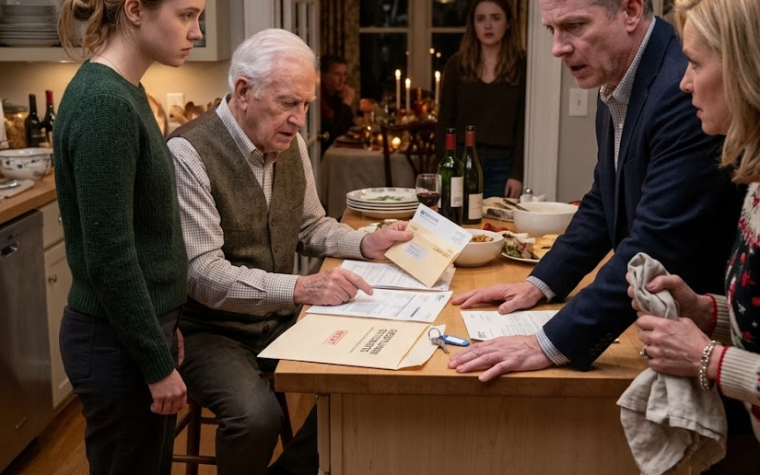
The property papers were being examined.
A prosecutor had contacted an independent magistrate judge for emergency search and seizure warrants.
“There is concern they may destroy records or move funds,” the agent said.
“They will,” Grandpa whispered from the bed.
The agent pulled a chair closer.
“Mr.
Arthur Cross, can you tell me where the records are kept?”
Grandpa closed his eyes, gathering strength.
“My son has a study behind the fireplace.
The cabinet looks built into the wall.
The key is taped beneath his desk.”
I had seen my father sitting beside that fireplace all evening.
From there, he could watch the room, guard the study, and pretend he had nothing to fear.
The magistrate judge approved the search warrants shortly after midnight.
Agents entered the study and found the concealed cabinet exactly where Grandpa said it would be.
Inside were original bank statements, copies of transfer requests, a second set of property documents, and a folder containing samples of Grandpa’s signature from old birthday cards and tax forms.
They also found records showing that proceeds from the sale of Grandpa’s house had moved through an account controlled by my parents before being used for the down payment on their new home.
The diamonds my mother had worn to greet me had been purchased two days after one of the largest withdrawals.
The evidence did not prove every crime by itself.
It did something more important at that stage: it replaced my parents’ story with a trail that could be followed.
By dawn, agents had followed it through accounts, closing documents, emails, and recorded calls with a bank employee who had questioned whether Grandpa understood the transfers.
My father had assured the employee that Grandpa was sitting beside him and agreed with everything.
Phone-location records later showed Grandpa had been at a medical appointment across town during that call.
When agents confronted my parents with the hidden cabinet, they turned on each other.
My mother said my father controlled the finances.
My father said she handled Grandpa’s signatures.
She accused him of deciding to use the shed.
He said she had ordered the padlock.
Every attempt to escape responsibility supplied another detail investigators had not yet disclosed.
At six in the morning, the independent prosecutor called me at the hospital.
A second judge had reviewed the affidavits and signed arrest warrants related to unlawful confinement, elder abuse, coercion, fraud, and theft.
I looked through the glass wall of Grandpa’s room.
He was asleep beneath heated blankets, his face still pale but no longer gray.
For the first time in hours, his hands were not shaking.
The prosecutor asked whether I wanted to be informed when the warrants were served.
“Yes.”
A secure line connected me to the team outside my parents’ house.
The lead agent confirmed both suspects were inside.
Their luggage had been found near the garage door.
My mother’s passport was in her handbag.
My father had transferred money between accounts less than an hour after I left for the hospital.
The fear of imminent flight had not been speculation.
The team leader said, “Warrants are confirmed.
Awaiting execution authority from the prosecutor.”
A moment later, the prosecutor gave it.
I heard myself say the words that had been waiting since I opened the shed.
“Execute the arrest warrants.”
The line remained open.
There was a knock, a command, and then my mother’s voice rising into the polished outrage she used whenever reality refused to obey her.
“You cannot enter my house.”
An agent answered, “We have a warrant.”
My father demanded to call his lawyer.
He was told he could do so after he was secured.
My mother shouted that her daughter was a federal judge, as though the truth she had mocked minutes earlier had suddenly become a shield.
The agent’s reply was calm.
“Judge Cross is a witness.