My father’s expression changed first.
Not to fear.
To calculation.
“You recorded us in our own home?”
“I recorded a conversation in which you admitted taking an elderly man’s property while he was locked in a shed.”
“You entrapped us.”
“I asked where Grandpa was.”
My mother folded her arms.
“A family disagreement is not a federal case.”
“Selling property through forged documents, moving funds across accounts, coercing signatures, and preparing to transfer the remaining assets can become one.”
The agent raised a hand before I could say more.
“Judge Cross, because you are a witness and a family member, we will need you to step back from any legal decision in this matter.”
“I already have.”
That mattered to me.
My parents had spent years treating authority as a weapon, and I would not become them simply because I finally possessed some.
I had made the emergency call.
I had reported what I witnessed.
I had preserved evidence.
But I would not sign a warrant, hear a motion, or touch the case from the bench.
Another judge would review the evidence.
Independent prosecutors would decide the charges.
My parents would receive every right they had denied Grandpa.
My father mistook restraint for weakness.
He leaned toward the agent.
“Then she cannot order you to do anything.”
“No,” the agent said.
“But the evidence can.”
The paramedics began wheeling Grandpa toward the ambulance.
I walked beside him until my mother called after me.
“Evelyn, think carefully.
If you do this, you destroy the family.”
I turned.
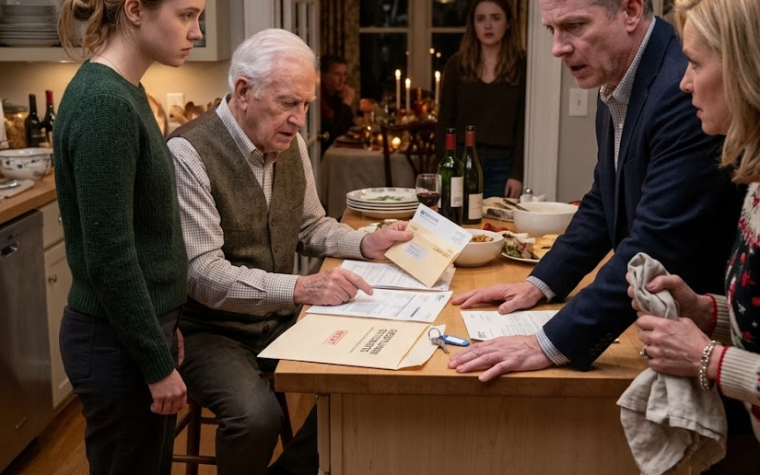
There she stood beneath the warm patio lights, diamonds at her throat, one hand resting on the table where the stolen documents had been found.
Behind her, the house they had purchased after selling Grandpa’s home glowed through walls of glass.
“You left me at a bus station,” I said.
“You locked him in a shed.
Do not call the moment someone stops you the moment the family was destroyed.”
My father’s voice became soft.
That softness had always been more dangerous than shouting.
“We can settle this privately.
Take Arthur.
We will transfer something to him.
You can leave, and no one needs to know what happened here.”
Grandpa heard him from the stretcher.
“Transfer something?” he repeated.
“It was mine.”
My father looked away.
At the hospital, doctors treated Grandpa for hypothermia, dehydration, and injuries consistent with being grabbed and restrained.
None of the injuries were immediately fatal, but the physician was blunt: another night in the shed could have killed him.
Grandpa asked the same question three times while they warmed him.
“Are they coming to take me back?”
Each time, I gave him the same answer.
“No.”
He watched my face as though testing whether promises could still be trusted.
Near midnight, a financial-crimes agent arrived at the hospital with an update.
The recording from my watch had been copied and authenticated.