The impact dropped me to one knee.
Rusk reached again.
I drove the folder’s metal clip across his knuckles and ran.
The clip sliced my palm.
Blood soaked into the corner of the cover as I pushed through the lower stairwell door.
At the hospital entrance, a nurse wrapped my hand and taped gauze over my temple.
Security officers arrived, but they had already been told I was a disgruntled employee who had assaulted a superior.
I knew that if I surrendered the folder to them, it could disappear.
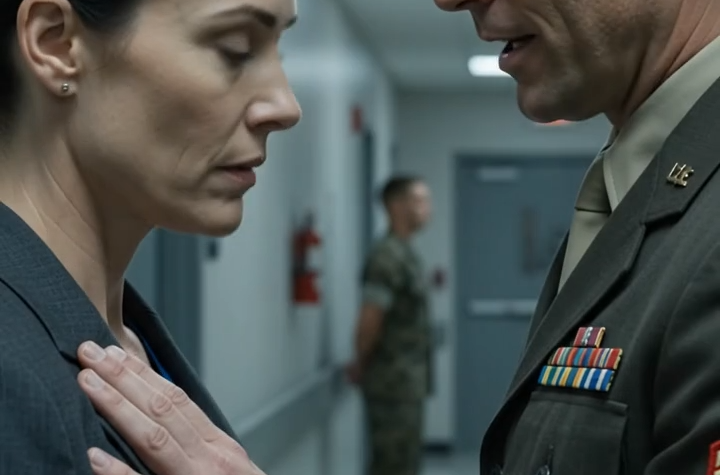
So I asked to speak directly to the commanding officer.
Colonel Whitaker had been told I was unstable.
He had been told I had violated privacy rules, threatened staff, and attacked Major Rusk after being confronted about poor performance.
When I entered his office, I was bleeding through the bandage on my hand.
He ordered me to place the folder on his desk.
I did.
Then I said, “Read page seventeen before you call anyone.”
At dinner, the colonel touched that page with two fingers.
“I almost had her removed,” he said.
Evelyn looked at him.
“Almost?”
“I believed my deputy.
I believed the reports that had passed through my own office.
And I was angry that a civilian employee had forced her way past security.”
He looked at me.
“Then she told me where I had been when I supposedly signed the authorization.”
He had opened the folder.
He read page seventeen, then page eighteen.
He compared the dates with his travel record.
He called the inspector general from a secure line and ordered military police to preserve every computer terminal connected to the medical-board system.
Within an hour, investigators had sealed the records office.
Within three hours, they discovered that deletion logs had been manipulated.
By morning, Major Rusk had been suspended.
“But Grace was fired,” Ethan said.
“Yes,” I answered.
The termination order had been entered eighteen minutes before Colonel Whitaker froze administrative actions.
Rusk had arranged it in advance and described me as a security risk.
Even after the investigation confirmed the altered records, the Army’s lawyers advised the hospital not to reverse the termination immediately.
They were afraid that doing so would appear to admit liability.
So I sued.
That was the lawsuit my mother mentioned in whispers.
The case became public.
Reporters called.
Former patients came forward.
Congressional staff requested records.
My photograph appeared beside headlines containing words like retaliation, fraud, and cover-up.
My family did not ask what had been uncovered.
They asked why I had agreed to be interviewed.
My father worried about his clients seeing our name in the news.
Ethan was in college and hated that people asked him whether I was “the military whistleblower.” Mom begged me to settle quietly.
“You said the attention was tearing the family apart,” I reminded her.
Tears appeared in her eyes.
“It was a terrible time.”
“For me too.”
The words left the table completely still.
Colonel Whitaker opened another section of the folder.
The investigation found that Rusk had altered or directed the alteration of thirty-one medical cases.
He had pressured staff to minimize diagnoses, erase complaints, and accelerate discharges so the hospital’s performance reports would meet command targets.