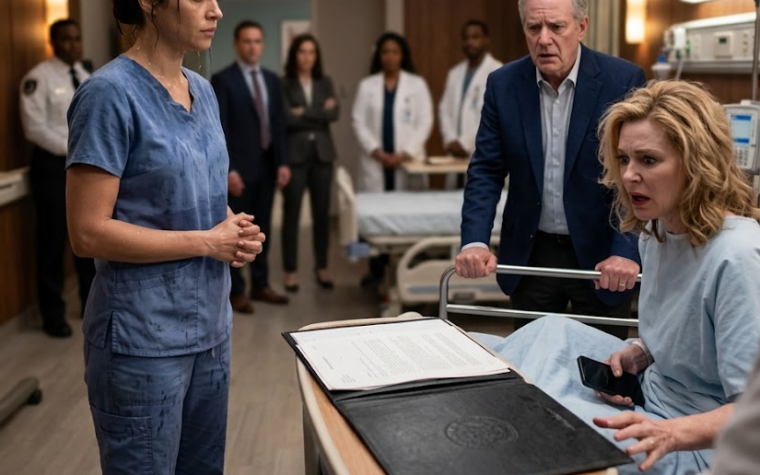
Colonel Whitaker opened the black folder to page seventeen and began reading my name.
“Grace Anne Mercer, civilian patient-records assistant, reported the first documented discrepancy on March fourteenth.”
His voice was steady, but his thumb pressed hard against the edge of the paper.
No one at the table moved.
The folder looked smaller than I remembered.
Seven years earlier, it had felt heavy enough to pull my shoulder from its socket.
Now it rested beside my untouched dinner plate, its corners softened, its metal clip bent, the dark stain on the cover faded from red to brown.
My mother stared at it as if it had been placed there to accuse her personally.
The colonel turned the page.
“She identified identical language in eleven separate medical evaluations,” he continued.
“She documented discharge recommendations entered after the listed physicians had left the facility.
She preserved copies of patient complaints that had been removed from the official record.”
Ethan looked at me.
“You did all that?”
“I noticed something wrong,” I said.
Mom gave a sharp breath.
“You were a clerk.”
The colonel closed the folder halfway.
“She was the only person in the building who refused to confuse rank with truth.”
Mom’s cheeks reddened.
“I wasn’t insulting her.”
“You called her work a crusade.”
“I’m trying to protect my son’s evening.”
Cassandra set down her napkin.
“Dad, start at the beginning.”
The colonel looked at me first, asking permission without words.
I nodded.
Seven years earlier, Fort Bellweather Military Medical Center had been praised for reducing the time injured service members spent waiting for medical review.
The numbers looked excellent.
Cases moved quickly.
Backlogs fell.
Senior officers received congratulatory reports.
What the reports did not show was how those numbers had been achieved.
I was twenty-two, working in the patient-advocacy records office while studying for the law-school entrance exam at night.
My job was simple: scan evaluations, log complaints, and route disputed medical-board files to the correct department.
The first file belonged to a young infantry sergeant whose rehabilitation request had been denied.
His final evaluation described his symptoms as temporary and mild.
Three weeks earlier, I had scanned a physician’s report describing the same injuries as severe and likely permanent.
The original report had disappeared.
I assumed it was a filing mistake until I found the same problem in another case, then another.
Diagnoses had been softened.
Complaints about treatment had vanished.
Requests for additional rehabilitation had been replaced by recommendations for immediate administrative separation.
The language was identical across files written by different doctors.
Even the punctuation matched.
I made a list of case numbers and brought it to my supervisor.
She looked at the page, closed her office door, and told me to stop comparing documents that had already been approved.
“Approved by whom?” I asked.
She pointed to the authorization block.
Colonel Thomas Whitaker’s initials appeared on every one.
At the dinner table, Evelyn turned toward her husband.
“Your initials?”
He nodded.
“Excellent copies of them.”
At the time, I did not know they were forged.
I only knew the records contradicted themselves.