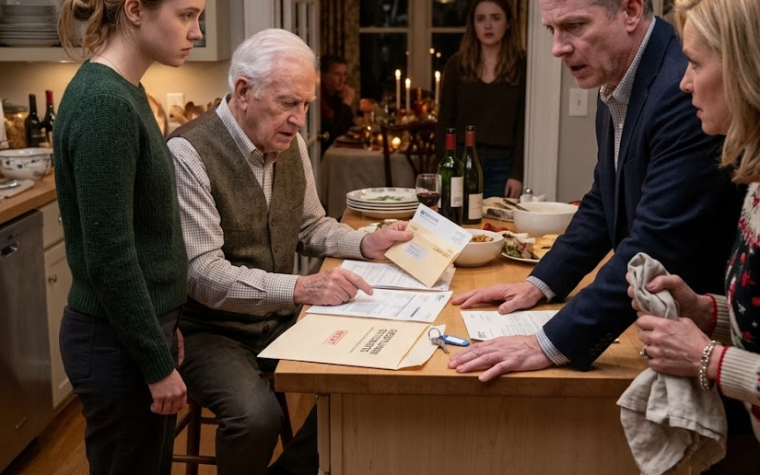
I had told the truth.
Those were separate actions.
Bethany and Kenneth found another temporary arrangement while they worked through their finances.
I did not ask for every detail.
For once, their housing was their problem to solve.
Bethany and I spoke carefully after that.
There was no magical reconciliation.
She apologized for joining the pressure campaign and for calling my house “the family house.”
“I think I started believing it,” she admitted.
“Mom said it so many times.”
“It was never true.”
“I know that now.”
I looked around my kitchen while she spoke—the counters I’d chosen, the coffee mug beside my laptop, the back door that stuck whenever it rained.
None of it was extravagant.
That was what made the fight so strange.
I had not been defending a mansion from desperate relatives.
I had been defending the basic idea that something could belong to me without becoming communal property the moment somebody else wanted it.
A month after Easter, Madison sent me a drawing through Bethany.
It showed my house with the blue door and the crooked lilac bush blooming purple beside the porch.
There were two stick figures in front.
One was her.
One was me.
At the bottom, in a child’s uneven handwriting, she had written that she hoped she could visit when I felt better.
I cried then.
Not at Easter dinner.
Not in the ER.
Not when my mother’s old key failed in the lock.
Then.
Because Madison had understood something the adults had refused to understand.
Visiting required an invitation.
Love did not erase ownership.
Family did not erase consent.
I called Bethany and told her Madison could come for lunch that weekend.
“Just Madison?” she asked carefully.
I smiled.
“You can bring Tyler too.”
“And us?”
I looked toward the spare bedrooms upstairs.
They were still exactly as they had been before Easter.
One held my office equipment.
One held boxes, books and a folded exercise bike I kept promising myself I’d use again.
Nothing about them looked like a battlefield.
They were simply rooms inside my home.
“For lunch,” I said.
Bethany laughed softly.
“For lunch.”
That Saturday, the children rang the bell instead of walking in.
I opened the blue door because I wanted to.
That difference was everything.
My forehead had healed to a thin pale mark by then.
The legal process involving my father was still moving through channels I could not control, and my parents were still angry that I had refused to protect them from the consequences of their own choices.
I could live with their anger.
What I could no longer live with was fear disguised as family obligation.
The folder my lawyer told me to keep remained in the bottom drawer of my desk.
Inside were screenshots, medical papers, the police information, and copies of the notices that had finally made my boundaries impossible to misunderstand.
I rarely opened it.