He said I had “destroyed the family over an accident.”
I read it once.
Then I added it to the folder.
The next day, an officer contacted me again.
They had spoken with the adults who were present.
Kenneth’s account matched mine.
Bethany’s account matched mine.
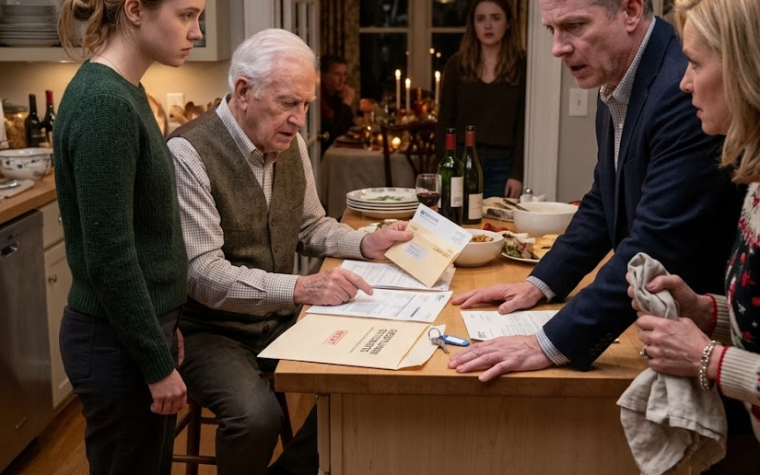
Photographs from the dining room showed broken glass and wine on the wall where I had been sitting.
My medical record documented the injury.
My father’s claim that the glass had simply slipped did not fit what the witnesses described.
He would have to answer for what he had done through the legal process.
When my mother learned that, she drove to my house.
I saw her car through the front window.
She marched up the walkway and tried the old key.
It no longer worked.
For several seconds, she stood there turning it harder, as if enough indignation could force the lock to remember her.
Then she knocked.
I didn’t open the door.
“Sally!”
I stood ten feet away, phone in my hand.
“I know you’re in there!”
I said nothing.
“Your father could be arrested because of you!”
That sentence almost pulled me toward the door.
The old version of me would have opened it to correct her.
Because of me?
He threw the glass.
He caused the injury.
He lied about it.
I wanted to explain all of that.
Then I understood why my lawyer had told me not to argue.
Explanations were where my family did its best work.
They could twist an explanation.
They could exhaust a defense.
They could bargain with guilt.
They could not bargain with a locked door.
My mother knocked again.
“Bethany has nowhere to go!”
From inside my own house, I finally answered.
“Then help her find somewhere she’s invited.”
Silence.
“Open this door.”
“No.”
One word.
No explanation.
No apology.
No debate.
She stood on the porch another minute before leaving.
I saved the security notification showing the visit, then called my lawyer and documented that too.
Over the following weeks, the Easter dinner stopped being a private family argument and became something my parents could not control with volume.
My father’s actions had legal consequences.
I did not celebrate them.
There was nothing satisfying about seeing a parent face consequences for hurting his daughter.
But I also refused to confuse sadness with responsibility.
He had thrown the glass.
I had gone to the hospital.