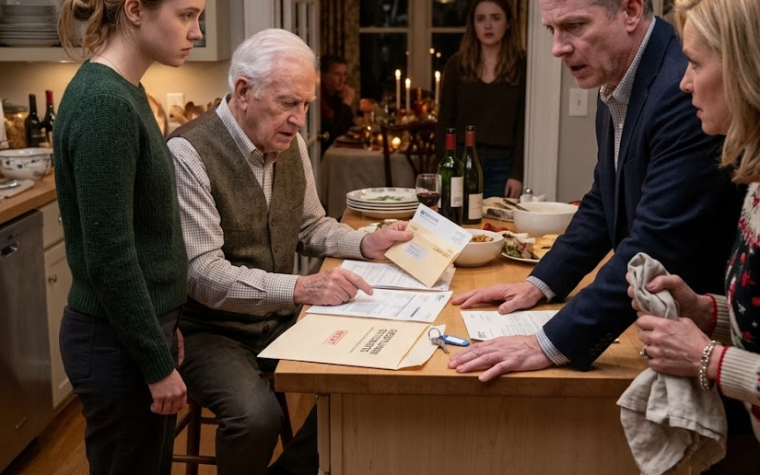
One answered the door.
One watched the children.
One sat beside an uncle whose hands had begun to shake.
One poured a small whiskey for him and then stayed until the shaking eased.
Meitheal.
I had heard the word before, usually in stories about neighbors helping with work too large for one family.
Harvesting.
Building.
Repairing.
But standing in our father’s crowded kitchen, I saw its other shape.
Grief was work too.
Not work that could fix anything.
Work that kept the people left behind from collapsing under what could not be fixed.
My brother lasted until nearly midnight.
By then the house smelled of tea, bread, damp coats, and the faint sharp sweetness of whiskey.
He had spent hours telling people we had enough food.
They kept bringing food anyway.
He told people not to stay too long.
Then he became offended when one old friend of Dad’s tried to leave early.
He told me he didn’t want tea.
I found three empty cups near the chair where he had been sitting.
Near midnight, I walked into the kitchen and found him alone.
He was staring at a sandwich.
Not eating it.
Just staring.
I went to lift the kettle.
“Leave it,” he said.
I froze.
For a moment I thought we were starting again.
Then he stood.
“I’ll do it.”
He filled the kettle himself.
The tap ran too long because he wasn’t watching the water.
When he switched it off, he stayed with both hands braced against the counter.
“I shouldn’t have said that to you,” he muttered.
I knew exactly what he meant.
Then act like it.
The sentence had stayed inside me all evening.
“No,” I said.
“You shouldn’t.”
He nodded.
I didn’t rescue him from the silence.
After a while, he looked at the mountain of borrowed dishes.
“Why do they do this?”
I could have given him history.
I could have told him about the old vigil, about communities gathering around a family home, about traditions carried across centuries and oceans.
Instead I said, “Because there isn’t anything else they can do.”
His face crumpled before he could stop it.
It was the first time he cried.
Not when the doctor spoke.
Not when the first relative arrived.
Not when he saw Dad laid out.
He cried while waiting for a kettle to boil.
I moved toward him, but he lifted one hand.
Not to push me away.
Just to ask for a second.