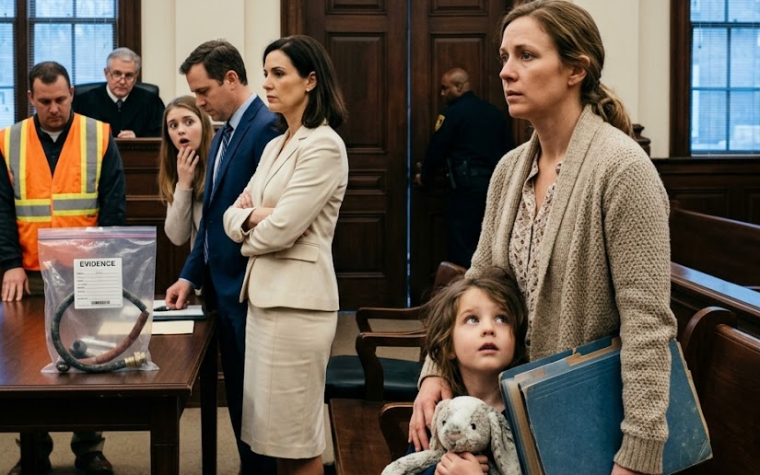
Each time Nathan corrected her, Caleb wrote the number down because, as he later told me, “They kept making the same mistake on purpose.”
One entry read:
414 becomes 714.
Another read:
Olivia signs first.
Blue numbers after.
A third contained an account sequence matching the one on page twelve.
Beside it Caleb had written:
Vanessa said move two before Friday.
Nathan’s lawyer objected that the notes were hearsay, incomplete, and impossible to verify.
The judge did not declare Nathan guilty of anything.
She did something far more dangerous to a man like him.
She ordered the records preserved.
No files could be deleted.
No trust assets could be moved.
No company-connected accounts listed in the settlement could be altered until the documents were authenticated.
The original folder, the electronic drafts, and the transaction histories would be examined.
Nathan stood so abruptly that his chair struck the railing behind him.
“You cannot freeze corporate funds because of a child’s notebook.”
The judge’s expression hardened.
“I am preserving disputed marital and trust assets because your filing contains inconsistent contract references and apparently altered schedules.
Your son merely identified where to look.”
Nathan glanced at Vanessa.
She had stopped smiling.
The hearing was recessed while the lawyers conferred.
Nathan crossed the aisle before anyone could stop him.
He did not look at Caleb.
He looked at me.
“You coached him.”
“No.”
“You filled that notebook.”
“No.”
“You have always been jealous of what I built.”
That almost made me laugh.
Years earlier, before Whitaker Global had towers, government projects, and Nathan’s face on magazine covers, it had occupied four rented rooms above a warehouse.
I had created the first internal controls, repaired the company’s cash-flow model, and discovered the reporting error that saved its largest early contract.
When we married, Nathan persuaded me to step away from daily operations.
He said one of us needed to build a stable home.
He promised my original voting shares and financial consent rights would remain untouched.
For years, I trusted that promise.
Six years earlier, I reviewed a quarterly statement and found expenses assigned to the wrong project.
I corrected them before the report went to the board.
Nathan thanked me in private.
Then he told everyone else that his finance team had caught the mistake.
When I objected, he gave me the sentence he repeated in our kitchen.
You are my wife, not my business partner.
I had mistaken erasure for peace.
Now, standing in the courthouse corridor, I saw the truth.
The $250 million was not generosity.
Nathan wanted my signature on a settlement that ratified false valuations, released future claims, and transferred my remaining consent rights back to him.
Once I signed, he could argue that I had reviewed and accepted every attached schedule.
He was not paying me to disappear from his life.
He was paying me to disappear from the paper trail.
“You should have taken the money,” he whispered.
My attorney stepped between us.
“Do not address my client again.”