“This will be referred to the independent ethics committee tonight,” she said.
“Mr.
Ellery, your committee access is suspended pending review.”
Knox stared at her.
“You cannot suspend me at a charity gala.”
“I can suspend you anywhere I discover conduct that creates a risk to the company and the foundation,” Evelyn replied.
“The location does not make the facts decorative.”
He looked to Dashell for rescue.
Dashell gave none.
Instead, he picked up the $100,000 check.
Knox had folded it once, perhaps intending to wave it around after I arrived as proof that the joke had worked.
Dashell unfolded it carefully.
The amount was visible to the people closest to us.
“You brought this here?” Dashell asked.
Knox’s face reddened.
“It was part of the joke.”
“You wanted an audience.”
“You invited her.”
“And I am responsible for that.”
Dashell tore the check once, then again.
The sound was small, but Knox flinched.
Tearing it did not repair anything.
Dashell seemed to understand that, because he did not look relieved afterward.
Evelyn asked the musicians to pause.
The sudden quiet drew the attention of the rest of the ballroom.
Dashell could have escaped through the service corridor behind the stage.
He could have asked security to clear the area or ordered his communications team to contain the story.
Instead, he walked to the microphone.
Wren watched him with no softness in her face.
“Before tonight’s program begins,” Dashell said, “I need to acknowledge conduct that violated the standards this foundation claims to represent.”
A few heads turned toward me.
He did not use my name.
I had asked him not to.
I did not want hundreds of strangers searching for my photograph or turning my humiliation into entertainment of a different kind.
He described the bet without identifying me.
He admitted his role.
He announced that Knox’s duties had been suspended and that an independent review would begin immediately.
Then he said, “An apology does not become meaningful because it is delivered from a stage.
The person I harmed owes me no forgiveness.”
When he stepped away from the microphone, no one applauded.
That was appropriate.
Knox tried to leave through the main entrance.
Two board members stopped him long enough to request his building credentials and foundation access card.
He dropped both into Evelyn’s open hand with a muttered warning about lawyers.
“Please call yours,” she said.
“Ours will contact them Monday.”
He passed me on his way out.
For a second, I saw the same expression he had worn in Dashell’s office—the certainty that status would protect him.
Then he noticed that nobody followed.
His shoulders lowered.
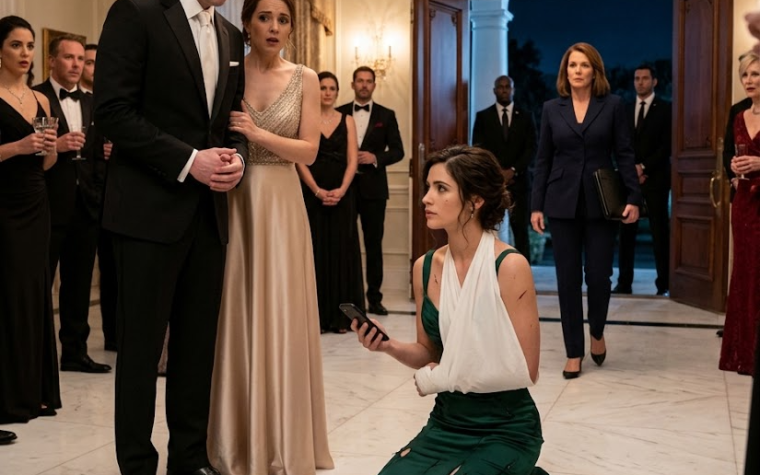
The gala continued, but the room had changed.
The laughter returned gradually and cautiously, directed toward safer things.
People approached me with apologies, compliments, and versions of concern that arrived too late.
One donor told me I looked stunning.
I thanked her, though I knew the emerald dress was not the reason Knox had gone pale.
He had gone pale because I had entered with evidence, a witness, and someone whose authority he could not dismiss.