You’re turning office banter into a board issue.”
“No,” Wren said.
“You turned an employee into a wager.
The witness is only describing it.”
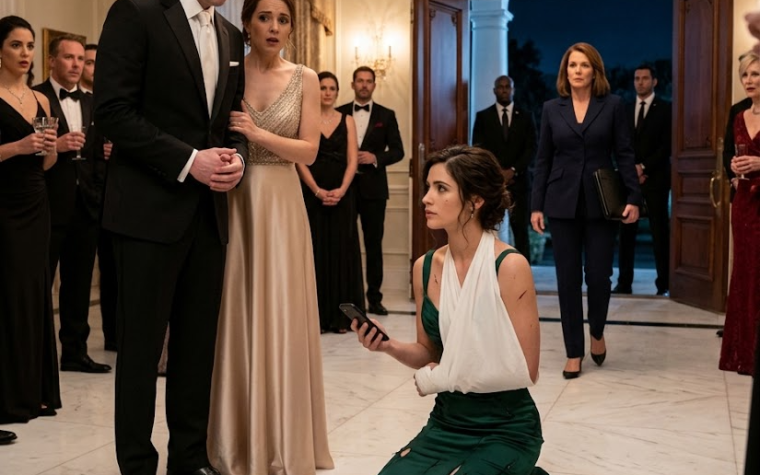
The Ashcroft Foundation’s chairwoman, Evelyn Shaw, approached from the center of the ballroom.
She was in her sixties, silver-haired, and usually impossible to unsettle.
Tonight, her eyes went immediately to the folder carrying the foundation seal.
“Wren asked me to review a personnel matter before dinner,” she said.
“I assumed we would discuss it privately.”
“So did I,” Dashell said.
Wren shook her head.
“The humiliation was designed for this room.
Why should the truth be hidden in another one?”
Dashell looked at his sister as though trying to recognize the person standing in front of him.
They had the same dark eyes and the same habit of becoming still when angry.
Until that night, I had never seen them together.
Now their resemblance was impossible to miss.
Knox finally noticed that the people nearest us included donors, directors, foundation officers, and two journalists invited to cover the gala’s scholarship announcement.
His confidence began to fracture.
He lowered his voice.
“Dash, take this upstairs.
We can handle it.”
Dashell did not move.
Wren rested one hand on the cream folder.
“You have spent years handling things by deciding which version protects you,” she told him.
“Tonight, someone else gets to speak.”
She nodded to me.
My throat felt tight, but my hands were steady.
“I worked for Mr.
Ashcroft for two years,” I began.
“I managed confidential schedules, prepared board packets, corrected travel contracts, coordinated legal filings, and prevented more than one mistake from becoming expensive.
Most mornings, I arrived before anyone on the executive floor.
Most nights, I left after the lights in this ballroom’s offices had gone dark.”
Dashell looked at me differently then—not with admiration, but with the discomfort of a man being forced to see work he had benefited from while ignoring the person doing it.
“I did not expect friendship from my employer,” I continued.
“I expected basic dignity.
Yesterday, I learned that my appearance had become entertainment for senior employees and that my boss believed I would accept any invitation because someone like me could not afford pride.”
Knox muttered, “That is not what he meant.”
Dashell turned on him.
“Stop speaking for me.”
For the first time that night, Knox fell silent.
I looked at Dashell.
“What did you mean?”
His eyes dropped to the check.
The question seemed to strip away every excuse he had been preparing.
“I meant exactly what you heard,” he said.
The admission moved through the room more powerfully than a denial would have.
Knox’s head snapped toward him.
“Dash.”
“I thought she would say yes because I assumed the invitation would matter more to her than the reason behind it,” Dashell continued.
“That assumption was cruel.”
He looked at me.
“And arrogant.”
Knox stepped back as if Dashell’s honesty had betrayed him.
Evelyn Shaw took the complaint from the folder and read the final page.
Her expression sharpened when she reached the section naming everyone present in the office.