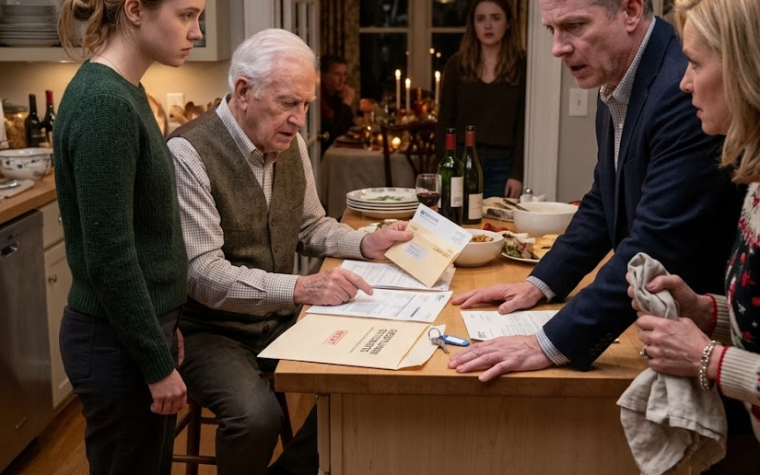
That was the part I wanted them to understand.
The convoy did not suddenly make what they’d done cruel.
The uniform did not make my pregnancy more vulnerable to the cold.
My rank did not make grief more legitimate.
They had been willing to humiliate me because they believed there would be no consequence.
Finding out I had authority merely forced them to look at behavior they had already chosen.
Harper recovered first.
“You’re making this sound worse than it was,” she said.
“I said it was temporary.”
I turned toward her.
“You told a six-month-pregnant widow to sleep in an unheated garage so Julian could have a home office.”
“I didn’t say unheated.”
“It isn’t heated.”
She opened her mouth, then closed it.
Julian stepped forward.
“Look, this is getting dramatic.
I could’ve worked somewhere else if it mattered that much.”
“You told me not to block your Audi.”
My father-in-law closed his eyes briefly.
Julian looked toward him for support and found none.
My mother-in-law set her coffee cup on the table.
“Evelyn, we were all upset.
Thanksgiving is difficult.
We lost David too.”
That sentence landed differently.
Because it was true.
They had lost him too.
Grief had carved something out of all of us.
But grief did not place words in their mouths.
It did not make Harper look at my pregnant stomach before telling me everyone was tired of watching me mourn.
It did not make Julian laugh.
It did not make my father-in-law tell me to stop acting helpless.
“I know you lost him,” I said.
“I never said you didn’t.”
My mother-in-law’s face softened, hoping she’d found a door back into the conversation.
Then I continued.
“But losing David doesn’t give you permission to erase me.”
No one answered.
Outside, another door on one of the military vehicles opened.
A senior officer stepped onto the pavement.
I recognized him immediately.
He had served with David years before, and later our professional paths had crossed more than once.
He had been among the officers who contacted me after David’s death.
When headquarters approved the secure-residence transfer, he had insisted that the escort acknowledge both of us.
He entered the house only after receiving my permission.
His expression changed when he saw David’s old Army T-shirt beneath my open jacket.
For one brief second, he was not looking at a colonel.
He was looking at his late friend’s wife.
“Evelyn,” he said quietly.
I nodded.
He didn’t offer condolences again.
He had already done that seven months earlier, and he knew there were moments when repeating them only reopened the wound.
Instead, he rested one hand on the handle of my suitcase.
“We’ll take this.”
My mother-in-law watched him.
“You knew David?”