I refused every request.
His attorney later sent a message asking me to clarify that Ryan had never personally struck me.
That sentence was technically true and morally worthless.
He had watched me beg.
He had refused medical care.
He had ordered his parents to leave me where I was.
He had listened to football while I dragged myself toward the door.
I gave the message to the investigator.
The court issued an order barring all three of them from contacting me.
Mrs.
Whitaker helped retrieve the few belongings I wanted after police cleared the house.
I did not take the wedding photographs.
I did not take the dishes Marjorie had chosen or the curtains Ryan said made the living room look respectable.
I took my laptop, my grandmother’s watch, three boxes of books, and the blue coat I had purchased with my first bonus.
I also moved my salary into an account Ryan could not reach.
He had spent years pretending I depended on him while using my income to preserve the life his parents expected.
Once my deposits stopped, the household pressure surfaced immediately.
Mortgage payments, credit cards, and private club fees no longer disappeared into the joint account under my name.
The family’s collapse was not caused by revenge.
It was caused by the removal of the person they had been exploiting.
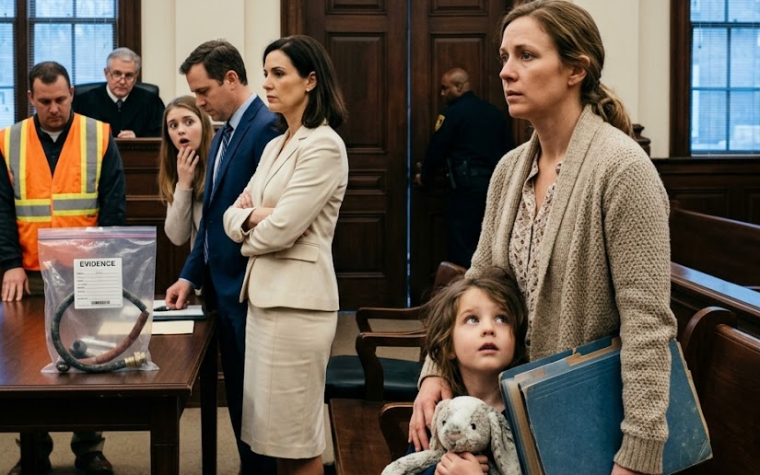
During the preliminary hearing, the recording from the hospital room was played in court.
Marjorie sat rigidly while her own voice said, “One strike to the leg, and suddenly she acts as if I tried to kill her.”
Howard stared at the table when his admission followed.
Ryan’s attorney objected to several portions, but the central statements remained.
Then Mrs.
Whitaker testified.
She described hearing three faint knocks beneath the sound of the rain.
She described opening her door and finding me in the mud, unable to climb the steps.
She described the way I kept whispering, “Please don’t let them take me back.”
Ryan finally looked away from me.
Months later, Marjorie accepted a plea that included a custodial sentence, mandatory counseling, and a permanent no-contact order.
Ryan entered a separate plea after the hospital recording and voicemails destroyed his claim that he had believed I was unharmed.
Howard avoided the harshest sentence by cooperating, but his agreement required him to testify truthfully about the plan to frighten me into surrendering control of my income.
None of them apologized without attaching an excuse.
Marjorie said she had been stressed.
Howard said he had frozen.
Ryan said he had been raised to protect his mother.
Their explanations differed, but every one of them asked me to carry part of the blame.
I refused.
The divorce took nearly a year.
Ryan fought over furniture he had once called ugly, disputed expenses he had approved, and accused me of destroying his reputation by telling the truth under oath.
I stopped reading his statements unless my attorney required it.
My leg healed more slowly than the case moved.
At first, I used a walker.
Then crutches.
Then a cane.
The first time I crossed a room without assistance, my physical therapist did not cheer or clap.
She simply stood nearby, ready but not touching me, while I placed one foot in front of the other.
That quiet respect nearly broke me.
For so long, help had always arrived disguised as control.
Ryan offered support only when it bought obedience.
Marjorie offered a home only when it made her the authority.
Howard offered peace only when I agreed to remain silent.
The hospital staff had shown me another kind of help—the kind that asked permission, preserved evidence, and stood beside me without taking my choices away.
A year after the night of the attack, I invited Mrs.
Whitaker to dinner in my new apartment.