My father looked away.
Sigard leaned toward me and kissed my forehead, the same quick gesture he had given me since medical school whenever he was rushing somewhere.
“Dinner later?”
“If you stay awake.”
He smiled.
“No promises.”
Then he disappeared through the corridor doors.
My parents watched him leave.
They had finally met their grandson.
There was no embrace.
No photograph.
No triumphant introduction.
Only the knowledge that he had looked directly at them and judged them not by blood, reputation, or the family name they had arrived carrying, but by what they had actually done.
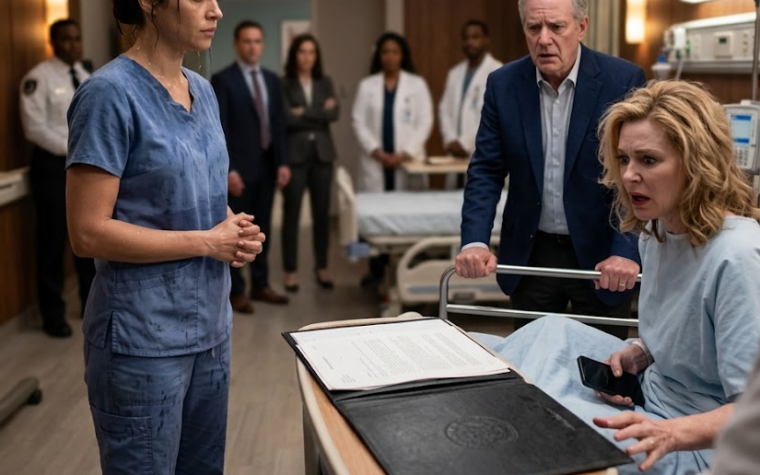
Lance returned the papers to the folder.
My father straightened his jacket.
The movement reminded me of that night twenty years earlier when he had set my suitcase beside the door and behaved as though neatness could make cruelty respectable.
“Are we finished?” he asked.
I looked at him.
“For today.”
My mother stopped beside me before leaving.
“Elena,” she said softly.
“Was she good to you?”
I could have answered with a list.
The room.
The restaurant job.
The school forms.
The nights she waited up when I worked late.
The way she held Sigard when he was born.
The anatomy books she bought secondhand because new ones cost too much.
The chair she occupied at every graduation.
Instead I said, “She stayed.”
My mother lowered her eyes.
That was enough.
They walked out through the glass doors together, quieter than when they entered.
No one in the lobby applauded.
No one needed to.
Life rarely gives you those clean endings.
There was no judge declaring a winner, no public punishment, no sudden restoration of the years that had disappeared.
There was simply a folder under Lance’s arm and an old truth that could no longer be rewritten.
In the months that followed, my mother sent two letters.
Not gifts.
Not invitations to public events.
Letters.
I read the first and put it away.
I read the second twice.
My father sent nothing.
Sigard did not ask me what he should do about them.
I didn’t tell him.
That choice belonged to him.
Eventually he agreed to read one of my mother’s letters.
Nothing changed overnight.
There was no instant family reunion.
There were only cautious boundaries and the possibility, perhaps, of an honest conversation someday.
I could live with that.
Because the thing I had wanted most at seventeen was no longer the thing I needed at thirty-seven.
Back then, I wanted my parents to open the door.