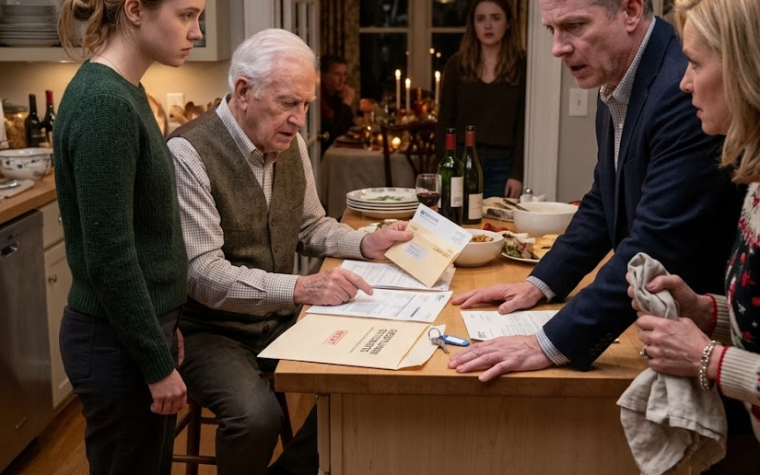
There it was: another betrayal, this time between them.
My son had allowed his wife to believe I was dependent because it made my labor easier to demand.
Perhaps he had even come to believe his own version.
It was more comfortable than remembering the checks, the transfer confirmations, and the day he accepted keys bought partly with my money.
The lawyer asked whether I wanted him to proceed with the filing.
My son placed both palms on the table.
“Mom, stop.
We can talk about this tomorrow.”
“We have been talking for months,” I said.
“You spoke.
I listened.”
“I was frustrated.
People say things.”
“You told me I could stay only if I worked for you.”
“That is not what I meant.”
“You sat ten yards away while your wife told me I was not worth your child’s diaper.”
His eyes shifted toward the guests.
He was still measuring the room, still worrying about how the story sounded rather than what had happened.
My daughter-in-law struck the table with the flat of her hand.
“So this is revenge? You will make your granddaughter lose her home because your feelings were hurt?”
I had expected that argument.
It placed the child between their behavior and its consequences, hoping I would carry the guilt for both.
“Your daughter will have a home,” I said.
“It may not be this house.
A child needs safety more than polished floors.
She also needs to learn that family members are not kept according to their usefulness.”
My son lowered his voice.
“Dad would hate this.”
For the first time that evening, anger moved through me.
It did not make me shout.
It made every word precise.
“Your father protected my name on that deed because he knew love should not require blindness.
Do not use a dead man to pressure me into accepting what he spent his life protecting me from.”
My son sat back.
The guests began leaving one by one.
Their goodbyes were quiet.
No one offered the cheerful promises to meet again that usually ended my son’s dinners.
The colleague who had first lowered his eyes paused beside me.
“Thank you for dinner,” he said.
It was a small sentence, but it acknowledged that I had been in the room as more than a pair of serving hands.
When the front door closed behind the last guest, the house became painfully still.
My son looked older than he had that morning.
“What do you want?” he asked.
It was the first useful question he had asked me in months.
“An accurate accounting,” I said.
“A fair buyout if you can afford it.
A sale if you cannot.
And until that is resolved, I will not babysit, clean, cook, or ask permission to occupy a house I own.”
My daughter-in-law laughed again, but there was no confidence in it.
“You expect us to buy you out of a house we maintain?”
The lawyer answered before I could.
“Maintenance will be included in the accounting, along with acquisition funds, taxes, insurance, principal payments, and documented improvements.
Neither side gets to invent the numbers.”
That ended the argument.
I picked up my phone.
“File the papers,” I said.