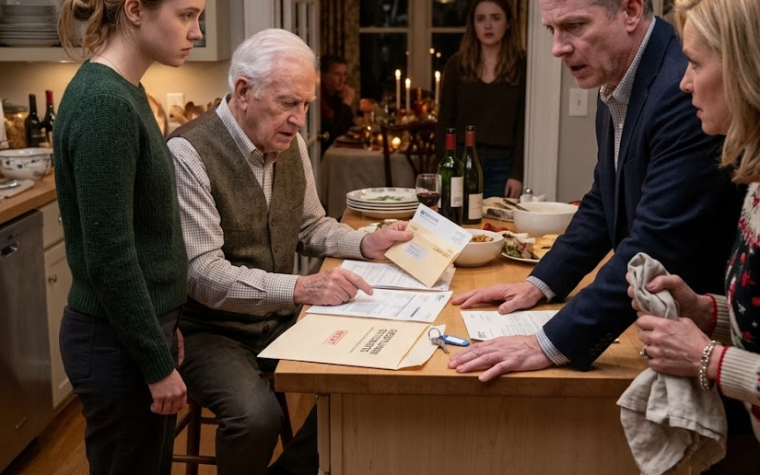
The lawyer’s voice filled the dining room while my son stared at the recorded deed beneath my hand.
“Before anyone discusses removing her from the property,” he repeated, “you should look carefully at whose name appears first.”
My daughter-in-law reached for the paper, but my son stopped her.
His fingers closed around her wrist, not roughly, but quickly enough to reveal that he already understood something she did not.
My name was printed above his.
For several seconds, the only sound in the room was the faint clink of ice settling inside a guest’s glass.
Then my son laughed.
It was not a natural laugh.
It came too loudly and ended too soon.
“Her name is there because I added her,” he said.
“It was symbolic.
She helped us a little.
That does not mean she owns the house.”
The lawyer did not raise his voice.
“A recorded ownership interest is not symbolic.
Neither are the transfers listed on the closing statement in front of you.”
I turned the next page.
The first record showed the money I had transferred when the offer was accepted.
The next showed the closing funds.
Behind those were receipts for property taxes, insurance, and several large expenses my son had once promised to repay.
I had not kept the records because I expected revenge.
I kept records because my husband had taught me that love and documentation served different purposes.
Love could be generous.
Documents had to be exact.
My daughter-in-law pushed back her chair.
“She gave us that money,” she said.
“It was a gift.
Everyone knows parents help their children.”
“Then you should be able to produce a gift letter,” the lawyer replied.
She looked at my son.
He looked at the papers.
There was no gift letter.
When they had found the house, they had already imagined themselves inside it.
My daughter-in-law had chosen paint colors before the inspection.
My son had walked through the kitchen describing where his colleagues would sit during holiday dinners.
Then the lender required more money than they could provide.
My son came to me late one evening with the listing photographs spread across my old dining table.
He spoke about school districts, safety, the baby they hoped to have, and the kind of life he wanted to build.
He did not call me weak that night.
He held my hands and said, “Mom, this could become the center of our family.
You would always have a place with us.”
I believed him.
I did not empty every account I owned, as they later assumed.
I used part of my savings and funds my husband and I had protected through decades of careful work.
I retained my pension, emergency reserves, and investments.
But the amount I contributed was substantial enough to make the purchase possible.
My husband’s lawyer handled the closing.
He asked my son to step outside before he spoke to me privately.
“Helping him is your decision,” he said.
“Disappearing from the paperwork should not be.”
He made sure my ownership was recorded.
At the time, my son had no objection.
He was too relieved to receive the keys.
For the first year, the arrangement resembled the promise he had made.
I had a bedroom, a chair by the window, and a place at the table.
When my granddaughter was born, I helped because I loved her.