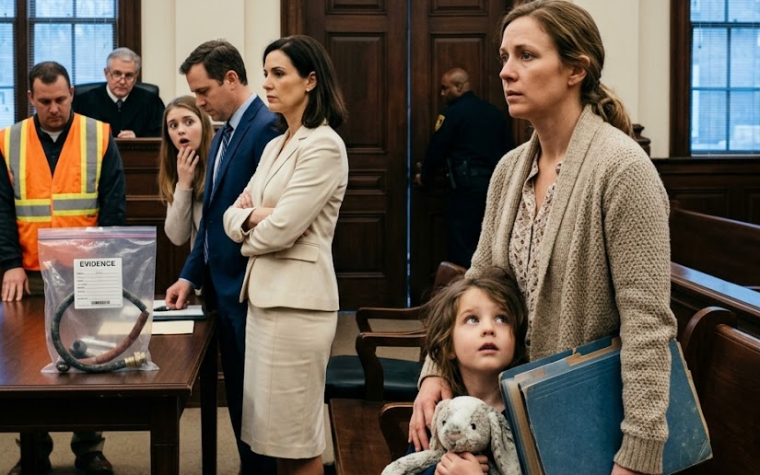
Details mattered.
Words became records, and records became the difference between a warning that vanished and one that somebody had to confront.
Over the following weeks, Daniel was contacted twice to confirm his account.
He learned only what he needed to know: the county had opened a formal review, the girls remained together, and their immediate placement was being maintained while professionals assessed the family’s situation.
There were no easy answers delivered to him.
Nor should there have been.
The case belonged to Emma and Grace, not to the man who happened to find them.
But one afternoon, Marisol called with a question.
The girls had asked about Rex.
A supervised visit had been approved.
Daniel brought him to a county family center several days later.
Grace saw the dog through the doorway and ran before anyone could remind her to walk.
She dropped to her knees and buried her face in his neck.
Rex’s tail struck the floor once, then again.
Emma followed more slowly.
She looked different in dry clothes with her hair brushed away from her face, but Daniel recognized the same watchfulness in her eyes.
“You came,” she said.
Daniel crouched beside Rex.
“You asked.”
Emma considered that.
Then she sat beside her sister.
For the next half hour, nobody talked about the freight yard.
Grace threw a soft ball for Rex.
Emma corrected Daniel when he exaggerated how lazy the dog had become in retirement.
For a little while they were not evidence in a report, names in a folder, or frightened figures under a borrowed jacket.
They were six-year-old sisters playing with a dog.
When the visit ended, Emma did not ask Daniel to promise he would see them again.
She had become suspicious of promises.
Instead she asked, “Can you try?”
Daniel understood immediately.
“I can try.”
Emma nodded.
That was enough.
Months later, the freight district was still part of Daniel’s occasional patrol route.
Whenever he passed the rusted container, Rex’s ears would lift.
Daniel never forgot what Emma had done there.
A child terrified enough to run had still placed herself between danger and her sister.
But the memory that stayed with him most was not her fear.
It was the moment inside the county center when she realized the adults around her were not going to send her away simply because procedure was easier than listening.
The folder had mattered.
The officers had mattered.
Claire and Marisol had mattered.
Even the locked door had mattered.
But what changed the night began with something smaller.
A former Marine had asked two frightened children what was wrong.
And when the answer became uncomfortable, he had not looked away.
For Emma and Grace, dignity did not return through one heroic gesture.
It returned piece by piece: a dry blanket, a dog that stayed still when a frightened hand reached for him, sisters allowed to remain together, questions taken seriously, and adults careful enough not to promise what they could not control.
Daniel had entered the freight yard expecting trespassers.
He left understanding why two six-year-old girls had believed a freezing shipping container was their safest option.
And after that night, every time someone described a child as difficult, distrustful, or unwilling to cooperate, Daniel remembered Emma watching his hands in the darkness.
Sometimes distrust was not defiance.
Sometimes it was memory.
And sometimes the first real act of protection was simply proving, one decision at a time, that this time the adults meant what they said.