She wanted doctors, teachers, and authorities to believe he suffered from a dangerous condition that required removal from his home.
She had placed herself at the center of every supposed solution.
She kept the symptom journal.
She selected the specialists.
She proposed the residential program.
She drafted the authorization naming herself as an emergency decision-maker.
She warned Alejandro that his refusal to trust her could be used against him if authorities believed he was neglecting Daniel.
The restaurant incident was supposed to be the final public proof.
There would be witnesses to Daniel’s collapse.
There would be an ambulance record.
There would be a frightened fiancée urging everyone to recognize the condition she had been documenting for weeks.
Maya’s scream destroyed the performance before Sofia could control the story.
When Sofia was interviewed again, detectives placed the prewritten email in front of her.
She read the timestamp twice.
Then she attacked Alejandro.
“He made that child the center of everything,” she said.
“Every dinner, every trip, every decision.
I was supposed to become his wife, but Daniel could change our plans by saying he felt tired.”
The detective asked why that justified secretly administering medication.
“I was trying to make Alejandro see reality.”
“What reality?”
“That Daniel needed somewhere structured.
Somewhere away from the house.”
“Because he was sick?”
Sofia’s composure cracked.
“Because he would never accept me.”
The words stayed in the interview room.
She tried to take them back, claiming exhaustion and panic.
She returned to the language of concern, insisting she only wanted Daniel evaluated.
But the evidence showed she had manufactured the symptoms she then used to justify removing him.
Alejandro watched part of the recorded interview two days later, after Daniel had been discharged.
His lawyer warned him that hearing Sofia’s voice might not help.
Alejandro listened anyway.
On the screen, Sofia complained that every room in Alejandro’s home carried the memory of Daniel’s late mother.
Daniel’s photographs filled the halls.
His school calendar controlled weekends.
His needs came before vacations, galas, and wedding planning.
“I was never going to have a real marriage while that boy lived in the center of it,” she said.
Alejandro stopped the recording.
He understood then that Sofia had never misunderstood his priorities.
She had understood them perfectly and believed she could rearrange them by making his son appear broken.
The wedding was canceled immediately.
The venue, vendors, and guests received no explanation beyond a private family emergency.
Alejandro would not allow Daniel’s trauma to become society entertainment.
A protective order barred Sofia from contacting either of them.
Prosecutors filed charges related to child endangerment, administering a substance without authorization, falsifying records, and attempting to manipulate an official investigation.
Sofia initially pleaded not guilty.
Her defense argued that she had made a reckless medical decision but acted out of concern.
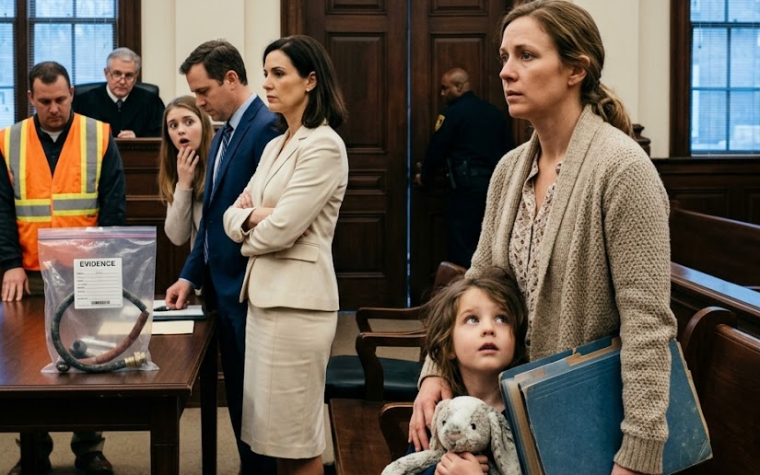
That argument collapsed under the prewritten email, the fabricated symptom logs, the anonymous complaint, the recovered packets, the restaurant footage, and Maya’s testimony.
Maya testified without dramatizing what she had seen.
She described the packet, the concealed movement, Daniel lifting his fork, and the instant she realized silence might place a child in danger.
Sofia never looked at her.
Before the trial reached a jury, Sofia accepted a plea agreement that required her to admit she had secretly administered the medication and falsified information to make Daniel appear medically unstable.
She received a prison sentence followed by strict supervision and a permanent order prohibiting contact with Daniel.
The legal outcome brought consequences, but it did not make Daniel stop checking his drinks.
For weeks, he asked who had prepared every meal.