“Three that I know of.”
“Who was present?”
Alejandro did not want to answer.
Saying the name made the pattern real.
“Sofia.”
The doctor’s expression stayed professional, but her next questions became more specific.
Had the episodes followed meals? Had Daniel become unusually sleepy? Had he complained of blurred vision, dry mouth, confusion, or weakness? Had anyone encouraged Alejandro to describe the incidents as neurological or behavioral?
Yes.
Yes.
And yes.
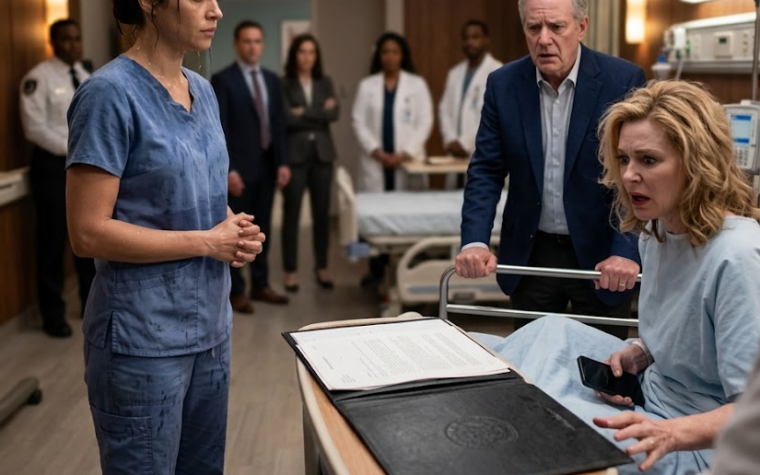
Alejandro sat beside the bed after the doctor left.
Daniel had fallen asleep, his breathing steady under the monitor’s quiet rhythm.
Alejandro’s phone filled with calls from his security director, his attorney, the restaurant manager, and members of his executive team who had already seen rumors spreading online.
He ignored all of them except his family lawyer.
“I need every document Sofia has sent you regarding Daniel,” Alejandro said.
“Every proposed authorization, every school form, every medical recommendation.”
There was a pause.
“Are you at the hospital?” the lawyer asked.
“Yes.”
“I received something this morning that did not make sense.
Sofia said you wanted her named as Daniel’s emergency medical decision-maker after the wedding.”
“I never said that.”
“I did not think so.
The request came with a draft letter describing Daniel’s condition as rapidly worsening.”
Alejandro looked at his sleeping son.
“Send everything to the detective.”
Less than an hour later, a preliminary screen found a sedating antihistamine in Daniel’s system.
It was not a medicine he had been prescribed, and there was no legitimate reason for it to have been placed secretly in his food.
The amount detected was not expected to cause permanent harm, the physician explained, but repeated exposure could create serious risks.
Daniel would remain under observation until the drug cleared and his vital signs stayed normal.
Alejandro absorbed only two words.
Repeated exposure.
The physician could not prove from one blood test that the earlier episodes had the same cause.
The police would need laboratory analysis, purchase records, witness statements, and whatever they could legally recover from Sofia’s belongings.
But the suspicion had entered the room, and it would not leave.
At the restaurant, Maya sat in the manager’s office giving her statement.
She described how Sofia had waited until Alejandro looked down at his phone.
She had seen Sofia remove a folded packet from her clutch, shield it beneath her palm, and empty it over the pasta.
Maya had first wondered whether it was seasoning.
Then Sofia stirred the powder into the sauce with Daniel’s fork, wiped the fork on his napkin, and pushed the plate closer to him.
That was when Maya screamed.
The restaurant’s security footage supported her account.
One camera showed Sofia watching Alejandro.
Another caught the motion of her hand over the plate.
The packet itself was too small for its markings to be visible, but her movements were clear.
She had not acted like a woman openly adding a harmless supplement.
She had acted like a woman who needed one moment when nobody was watching.
The manager also preserved the trash collected from the dining room.
Inside a small liner near table twelve, investigators found the torn edge of a pharmaceutical wrapper.
Its lot information matched the type of medication indicated by Daniel’s initial screen.
When detectives confronted Sofia, she changed her explanation.
First, it had been a natural allergy product.
Then it became an over-the-counter medication Daniel had taken before.
Finally, she claimed Alejandro had asked her to give it to him but must have forgotten.
Alejandro’s attorney provided Daniel’s medical records.
No doctor had prescribed that medicine for Daniel.