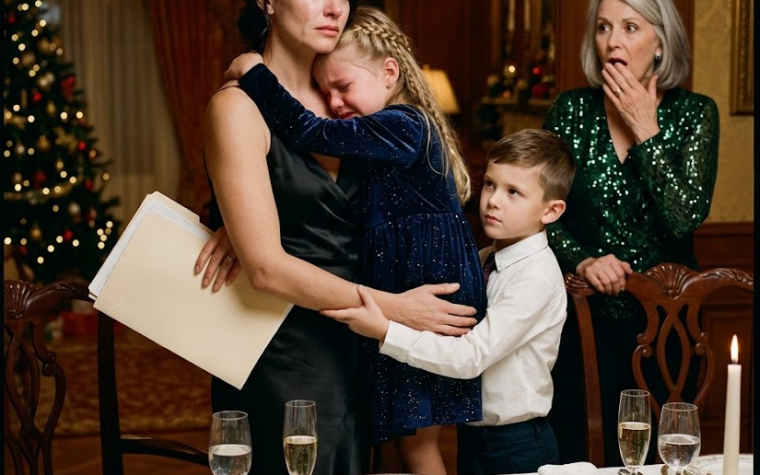
Lily read from it.
“Mom said, ‘If the doctors say you are incompetent, who controls your voting shares?’ Dad told her to leave.
Uncle Richard said, ‘Don’t make this harder than it has to be.'”
Richard’s face reddened.
“That’s absurd,” he said aloud.
The judge’s gaze snapped toward him.
“Mr.
Reynolds, you will remain silent.”
Richard leaned back, but the calm confidence he had displayed all morning was gone.
Lily continued.
“Dad closed his office door after that.
He thought I was in my room.
I was in the hallway because I wanted water.”
“What else did you hear?”
“Uncle Richard told my mother that if she had legal authority over Dad, she could approve someone to manage the company.
She asked whether that someone would be him.
He said, ‘Who else can keep it in the family?'”
This time, the courtroom did not whisper.
It went completely silent.
My mother’s attorney rose slowly.
“Your Honor, we strongly dispute this account.”
“You will have an opportunity to respond,” Judge Martinez said.
She examined the page, then asked Lily whether anyone had helped her write it.
“No.”
“Why did you keep it?”
“Because Dad said court is about proof, not who looks the saddest.”
For the first time that morning, a faint expression almost like approval crossed the judge’s face.
Lily reached into the back pocket of the folder.
“There is something else.”
She removed a sealed envelope.
On the front, in her handwriting, were the words For Judge Martinez.
The judge opened it.
Inside was a letter Lily had written after her final appointment with the psychologist.
She had not shown it to her father or his attorney.
The psychologist confirmed that Lily had asked how a child could give the court a private statement without either parent changing it.
She had explained the process but had not suggested what Lily should write.
Judge Martinez read silently.
The letter did not ask the court to pretend Lily’s father was healthy.
It said the opposite.
My dad is sick.
I know he may get worse.
I know we may need help.
But needing help is not the same as being dangerous, and being sick is not the same as being gone.
It described the plan her father had already made.
He had arranged backup transportation, meal support, medical monitoring, and authority for trusted professionals to help if his condition changed.
He had spoken honestly to Lily about the diagnosis without asking her to keep secrets or comfort him.
Then the letter addressed her mother.
I am not asking the court to punish her for leaving.
I am asking the court not to reward her for coming back only when Dad’s company became part of the conversation.
Judge Martinez finished reading and placed the letter beside the folder.
Lily’s mother sat rigidly, both hands clasped together.
Her attorney requested a recess.
The judge denied it.
“You presented this matter as an emergency,” she said.
“We will continue.”
My father’s attorney stood and asked permission to recall Lily’s mother for limited questioning based on the child’s testimony.