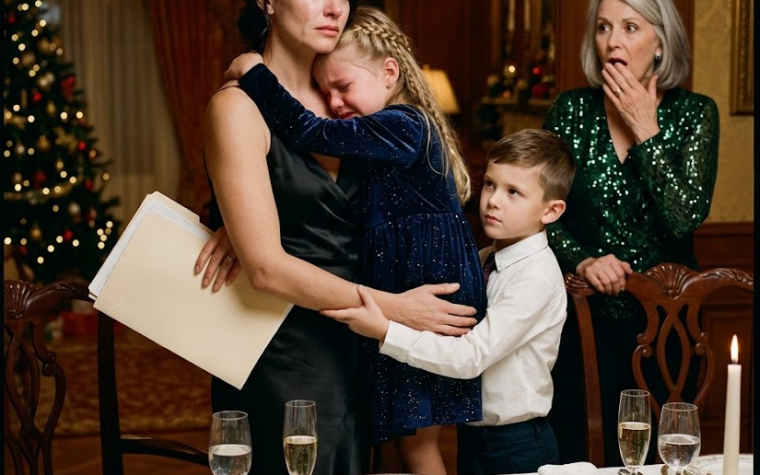
Judge Elena Martinez held the first page beneath the courtroom light.
At the top, in Lily’s careful handwriting, was a date from nearly three years earlier.
Below it were four words.
Mom missed my birthday.
No one spoke.
The judge turned the page.
Another date.
Mom did not call.
The next page recorded a school concert.
The next, a parent-teacher conference.
Then a hospital appointment, a holiday, and the morning Lily’s father had received his diagnosis.
Each entry was brief.
There were no dramatic drawings, angry paragraphs, or insults.
Lily had written only what happened, who was present, and who was absent.
Her father had attended every event.
Her mother had attended none.
Judge Martinez looked over the folder at Lily.
“When did you begin keeping these notes?”
“After my mother came back,” Lily said.
Her voice was quiet, but the microphone carried it through the entire courtroom.
“Why?”
Lily glanced toward her mother.
“Because she kept saying she had always tried to be part of my life.
I thought maybe I remembered it wrong.
So I checked.”
The judge’s expression softened, but her tone remained formal.
“How did you check?”
“School calendars.
Messages on Dad’s old phone.
Birthday cards.
Appointment papers.
My teacher helped me find the dates of school events, but she didn’t know why I wanted them.”
My mother’s attorney rose.
“Your Honor, this is a child’s scrapbook, not admissible evidence.”
“Sit down,” Judge Martinez said.
“I have not ruled on anything.
I am listening to the child whose future everyone else has spent the morning discussing.”
The attorney sat.
Lily opened the folder wider.
Inside were plastic sleeves holding report cards, attendance records, school notices, and copies of emergency contact forms.
Her father’s name appeared on every form.
His signature sat beneath permission slips, medical releases, and parent conference confirmations.
Her mother’s name appeared only in the section marked biological parent.
Next to contact number, the space was blank.
Lily pointed to one of the forms.
“My school asked for her number every year.
Dad said he would add it if she contacted us.
She never did.”
Her mother shook her head slowly, performing disbelief.
“Lily, sweetheart, you don’t know what happened between the adults.”
Judge Martinez looked up.
“Ms.
Reynolds, you will not address the witness unless instructed.”
The word witness changed the room.
Until that moment, most people had seen Lily as a child waiting for adults to decide where she belonged.
Now every person in the courtroom was watching her as someone whose memory mattered.