At first, Clara answered cautiously.
She feared each truth might be judged as a complaint.
Slowly, she understood that Eleanor was learning to listen without treating need as insolence.
The children continued coming for breakfast.
The oldest stopped examining every doorway as though expecting to be sent away.
The second began describing the shapes seen in the chandelier crystals.
The youngest still loved bread most of all, but he no longer clutched each piece as though it might be his last.
One morning, Eleanor found him holding a roll without eating it.
“Is something wrong?” she asked.
He shook his head.
“I am saving it.”
“For later?”
“For Mama.”
Across the room, Clara turned away and pressed her fingers to her mouth.
Eleanor wrapped another roll and placed it beside Clara’s plate.
“There is enough for both of you,” she said.
The child considered this with the solemn attention of someone encountering a new idea.
Enough.
Not scraps divided carefully.
Not a mother pretending she had already eaten.
Not children waiting beside an empty plate for the sound of footsteps.
Enough.
Months passed, and the mansion changed in ways visitors could not always identify.
The rooms remained grand, but the household no longer treated waste as proof of abundance.
Meals were planned with care.
Leftovers were preserved and distributed.
Clara’s hours were adjusted so she could spend evenings with her children rather than returning after they had fallen asleep.
The greatest change, however, was less visible.
Eleanor began seeing the people inside the work they performed.
Clara was no longer part of the furniture of the mansion.
She was a mother with sharp judgment, quiet humor, aching hands, and an extraordinary ability to endure without becoming cruel.
Their relationship did not transform into an easy friendship overnight.
Too much inequality stood between them for sentimental gestures to erase it.
Clara still called her Madam.
Eleanor still employed her.
There were moments of awkwardness and disagreement.
But there was also honesty.
When Eleanor spoke carelessly, Clara no longer lowered her eyes and swallowed the truth.
When Clara needed help, she asked before desperation forced her to choose between obedience and hunger.
And Eleanor learned that dignity was not something the powerful handed down.
It was something they either respected or stole.
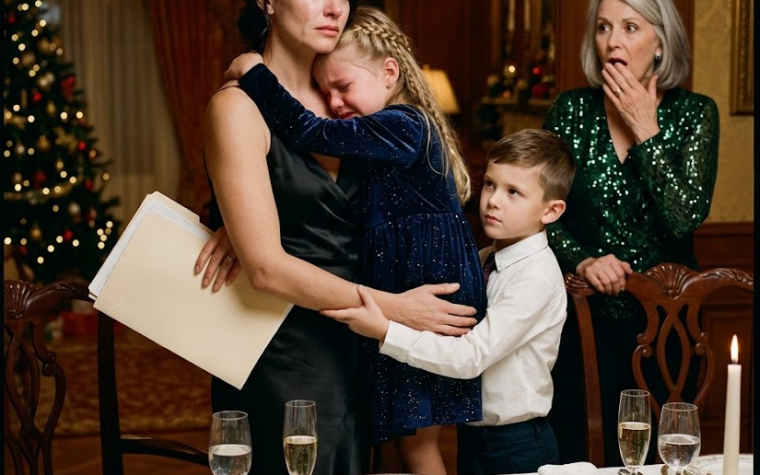
One evening, nearly a year after the cloth bag had fallen onto the marble floor, Eleanor entered the dining room after the guests had left.
Clara was standing beside the same table.
For an instant, the memory returned with painful clarity: the hidden bread, the trembling hands, the cold accusation.
But Clara was not hiding anything now.
Four parcels rested openly on the table.
Three were for the children.
One was for Clara.
The youngest child waited in the doorway, taller now and less afraid of the room.
He pointed to the bread basket.
“May I take one more?”
Clara looked toward Eleanor, an old habit flickering across her face.
Eleanor picked up two rolls and placed them in his hands.
“You never need to be afraid to ask for food here,” she said.
The child smiled and ran back toward his mother.
Clara lifted the parcels.