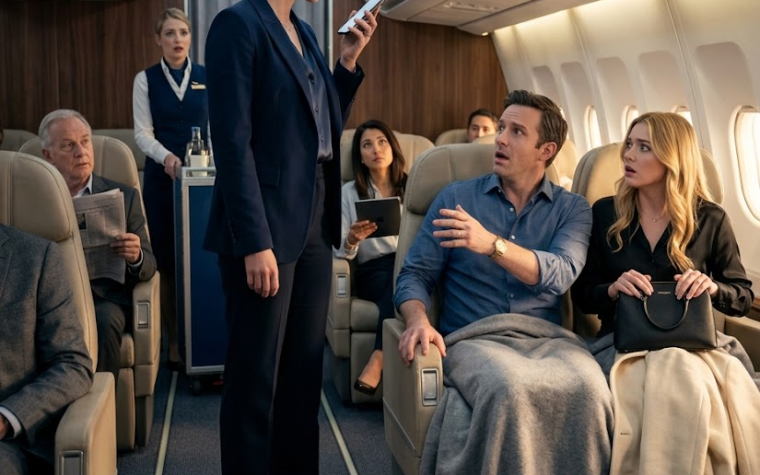
Her hands shook as she admitted that she had heard Carolyn’s words and had been afraid to intervene.
“I knew it was wrong,” she said.
“I thought if I challenged her and she complained, I’d be disciplined.”
I believed her.
That did not erase the failure, but it revealed another part of it.
Dennis had not acted in isolation.
Our service culture had taught employees to fear wealthy customers more than they respected written policy.
Status had become a weapon, and silence had become the shield around it.
“Write exactly that in your statement,” I told her.
“Do not soften it to protect the company.”
While we continued toward our destination, the investigation at Gate B22 moved quickly.
Dennis attempted to reopen the passenger records, but his access had already been suspended.
When airport operations questioned him, he claimed that I had become aggressive and demanded a free upgrade.
The video disproved him.
He then claimed Carolyn had been assigned 2A before I arrived.
The scan log disproved that.
Finally, he said the words captured by the gate microphone had been taken out of context.
There was no context in which they became acceptable.
A review of his previous shifts revealed that my case was not the first.
Several complaints had been closed without interviews.
In three of them, passengers of color had lost premium seats after boarding staff made undocumented changes for high-spending travelers.
Each record carried the same phrase Dennis had used on mine: voluntary passenger accommodation.
Corporate investigators contacted the affected passengers before our aircraft landed.
Two still had photographs of their original boarding passes.
One had kept an email she had sent the airline that was never answered.
Another remembered Dennis telling him not to make trouble if he wanted to fly that day.
By the time we touched down, the problem was no longer one stolen seat.
It was a pattern.
At the arrival gate, corporate security and airport representatives waited near the jet bridge.
They did not storm the aircraft or create a public spectacle.
The captain asked passengers to remain seated for a moment, then allowed Carolyn and me to leave separately for interviews.
Carolyn emerged from Row 12 speaking rapidly into her phone about attorneys, defamation, and the amount of money she spent each year.
When an investigator asked whether she had pushed me at Gate B22, she called it accidental contact.
When asked about her statement near the lavatory, she claimed she had meant First Class passengers should use one facility and economy passengers another.
The aircraft layout proved there was no such rule.
The witnesses proved what she had actually said.
I provided my statement and the marked boarding pass.
I did not demand that Carolyn be handcuffed, and I did not threaten to ruin her.
I asked that the same passenger-conduct policy be applied to her that would have been applied to anyone without money or influence.
The airline suspended her travel privileges that evening.
After the formal review confirmed the shove, the discriminatory harassment, and her refusal to accept responsibility, the suspension became a permanent ban from every carrier controlled by Meridian Crown Group.
Her elite status was canceled.
The miles and privileges she had used as proof of superiority disappeared from her account.
Dennis was placed on leave before the flight landed.
He received a hearing, representation, and an opportunity to answer the evidence.
The video, audio, false record entries, and earlier complaints left little room for explanation.
His employment was terminated, his airport credentials were surrendered, and the case was referred to the airport authority for an independent civil-rights and misconduct review.
The other failures were harder to confront because they belonged to the company I led.
We reopened every discrimination complaint closed by Dennis’s station during the previous two years.
Passengers who had been improperly downgraded received refunds, compensation, and personal calls from senior leadership.
An outside firm was hired to audit seat overrides and complaint handling across the entire network.
We changed the system so no gate supervisor could erase a confirmed premium assignment without a recorded reason and a second employee’s approval.
Camera footage connected to a discrimination complaint would be preserved automatically.
Employees received direct protection for intervening when high-status passengers harassed others.
Performance bonuses were separated from elite-customer satisfaction scores whenever those scores conflicted with safety or equal treatment.
A month later, I placed the crossed-out boarding pass on the table during a board meeting.