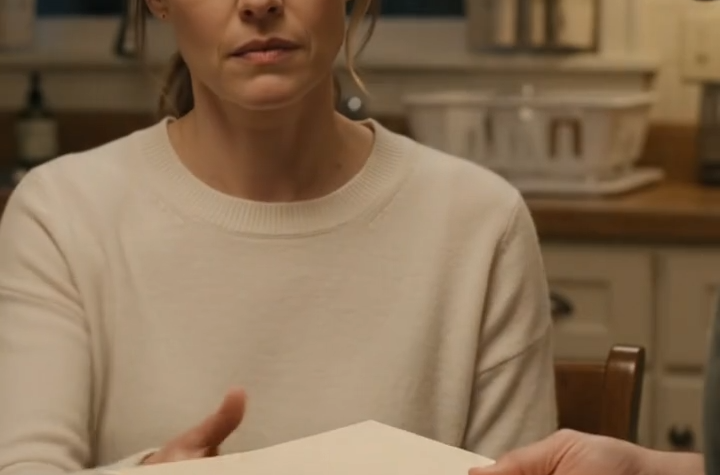
“Display a weapon?”
I stared at the table.
“No.”
The attorney placed the transcript of my call beside the photograph.
“Then what made him suspicious?”
I began talking about the vest, the motorcycle, and neighborhood standards.
The attorney let me continue until I had nowhere left to hide.
“What feature of the man made you decide he did not belong?”
My own lawyer told me to answer only the question.
I said the biker was large.
The attorney reminded me that I had not reported every large man who entered Brookhaven Lane.
I said he was dressed differently.
The attorney showed me photographs of white residents wearing motorcycle jackets at neighborhood gatherings.
Finally, exhausted and angry, I said the sentence that ended any chance of explaining the incident away.
“He was a Black man on a motorcycle in front of an expensive house.”
The room became silent.
The biker sat across the table.
He did not smile.
He simply watched the court reporter record the words.
Months later, those words were played for a jury alongside my dispatch call and the video from the cul-de-sac.
The jurors saw the officers approach him as if he might be armed.
They saw him move slowly so no one would mistake his hands.
They saw me step onto my porch, protected by distance and certainty, and tell him that men like him did not belong.
The biker testified last.
He described purchasing the house after years of saving.
He had chosen Brookhaven Lane because the property had a workshop large enough for his motorcycle and a small room he planned to turn into an office.
He had expected repairs, moving expenses, and the ordinary discomfort of meeting new neighbors.
He had not expected his first act as a homeowner to be proving to armed officers that he was entitled to stand in his own driveway.
His attorney asked what frightened him most that morning.
“The lie,” he said.
“I knew I had done nothing wrong.
But I also knew the officers had been told I had a gun.
Once someone puts that picture in their minds, being innocent does not make you safe.”
The jury found that I had intentionally interfered with his housing rights, defamed him, and acted with reckless disregard for his safety.
The award included compensatory damages, punitive damages, and attorney fees.
The total exceeded my savings.
A judgment lien attached to my house.
For several weeks, I insisted I would appeal.
My attorney explained that an appeal would cost more money and would not erase the recordings, the messages, the incident log, or my deposition.
The evidence was not a misunderstanding that could be argued into something gentler.
It was a pattern written in my own words.
I sold the house on Brookhaven Lane the following spring.
The proceeds paid the mortgage, legal bills, and most of the judgment.
Nearly everything I had spent twenty-two years protecting disappeared in a series of wire transfers.
The safety committee position was already gone.
Several neighbors no longer spoke to me.
The reputation I had treated like property could not be packed into a moving box.
On the morning the movers came, the biker stood in his driveway beside the motorcycle.
His house no longer looked vacant.
The porch rail was straight, warm light filled the windows, and fresh paint covered the door I had watched for eight months.
I walked across the street despite the order limiting contact.
I stopped at the curb, careful not to step onto his land.
“You got what you wanted,” I said.
He looked at the moving truck behind me.
“No,” he replied.
“I wanted a house.”