I turned toward him.
“You don’t know what this neighborhood was like before people started coming through here at all hours.”
He glanced at the silent houses, the trimmed hedges, and the three phones still aimed at us.
“It was ten in the morning,” he said.
The officer asked me to explain the weapon I had claimed to see beneath his vest.
I said I had been mistaken.
He asked what object I had confused with a handgun.
I had no answer.
The biker’s motorcycle had a small camera fixed near the handlebars.
It had recorded his arrival from the moment he turned onto Brookhaven Lane.
The footage showed him parking, removing his gloves, checking the address on the mailbox, and taking out his key.
It showed that his hands had never gone near anything resembling a weapon.
It also captured my voice from across the street when I stepped onto the porch and announced that men like him did not belong there.
The older officer told me that making a knowingly false report was not neighborhood vigilance.
He said falsely describing a weapon could cause an innocent person to be injured or killed.
I accused him of threatening me.
His expression hardened.
“No, ma’am.
I’m explaining why your statement matters.”
The police did not arrest me that morning.
They took my information, preserved the dispatch recording, and instructed me not to enter the biker’s property or interfere with him.
The older officer asked the biker whether he wanted to make a formal complaint.
The biker looked at the house he had just purchased.
“Yes,” he said.
“I do.”
Then he carried his folder inside and closed the door.
I should have stopped speaking after that.
Instead, before the police cars had left the cul-de-sac, I sent an email to nearly every household on Brookhaven Lane.
I claimed an aggressive stranger had moved into the vacant house and had used legal threats to intimidate me.
I warned people to secure their homes, watch their children, and document any unusual activity involving the motorcycle.
I wrote that I had seen something under his vest.
I wrote that the police had refused to protect us.
I wrote that property values would suffer if residents remained silent.
By lunchtime, one of my neighbors forwarded the entire message to the biker.
He did not respond to the group.
His attorney did.
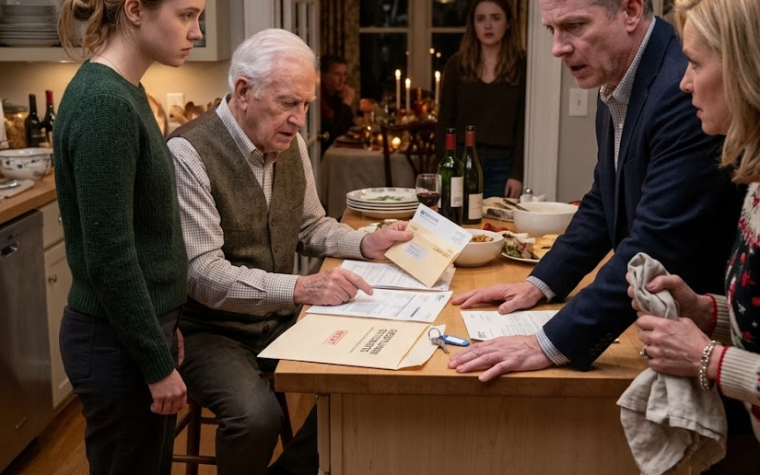
A preservation notice arrived at my house two days later.
It instructed me not to delete emails, messages, security recordings, neighborhood posts, or communications concerning the vacant property, its visitors, the seller, or the new owner.
I laughed when I read it.
Then a second envelope arrived from the city confirming that investigators were reviewing my police report.
A third came from a civil rights attorney representing the biker.
It listed potential claims for discriminatory interference with housing rights, defamation, harassment, and intentional infliction of emotional distress.
The recorded deed was attached again.
So was a transcript of my call to the dispatcher.
The words looked uglier on paper than they had sounded in my kitchen.
Black male.
Large.
Suspicious.
Possibly armed.
The transcript also included the dispatcher asking whether I had actually seen a weapon.
My answer was clear.
“No, but men like that usually carry something.”
I had forgotten saying it.
The recording had not.
At first, I insisted the biker was trying to frighten me out of my own home.
I told neighbors that I would expose him.