She left without another word.
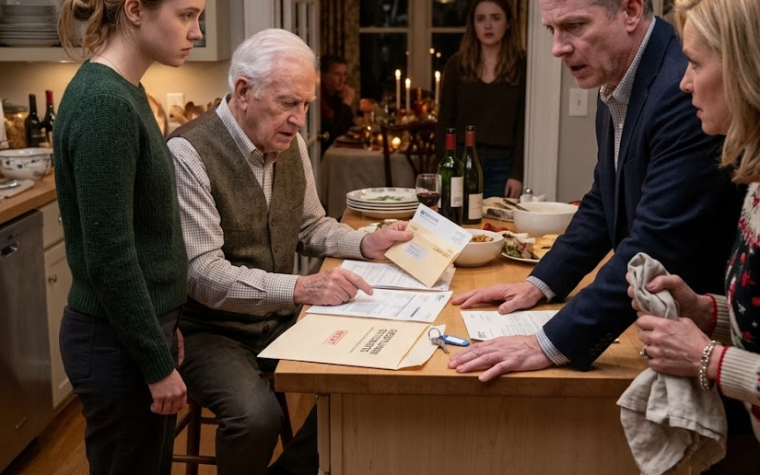
After the front door shut, Lucas and I stood in the wreckage of his birthday dinner.
The candles had burned down into the frosting.
One of the paper plates had fallen to the floor.
The folder remained open on the table like a trap that had failed to close.
Lucas sat heavily in his chair.
“I’m sorry.”
“For what?”
“For not telling you sooner.”
He explained that he had gone into the attic that morning looking for the old string lights Mom used on birthdays.
Behind a loose panel, he found the jewelry box wrapped in one of her scarves.
An envelope had been taped beneath it.
On the front, Mom had written: For Lucas on his eighteenth birthday.
Give the box to Emma before anyone asks you to sign papers.
He had planned to wait until after dinner.
Then my aunt arrived with the folder, and everything happened exactly as Mom’s note had warned.
“There was another sentence,” Lucas said.
He removed the note from his pocket and handed it to me.
The final line read: What Emma learns may hurt her, but losing the truth will hurt both of you more.
I read it twice.
“What truth?” I asked.
Lucas shook his head.
“I didn’t open her envelope.”
We slept badly.
The next morning, we arrived at Helen Harper’s office before it opened.
She was in her sixties, with silver hair and the kind of steady expression that made panic feel embarrassing.
She locked the door behind us, placed Mom’s jewelry box on a conference table, and asked whether we were ready.
I opened the sealed envelope.
The first page was a letter written in Mom’s familiar sloping handwriting.
My dearest Emma,
There is no gentle way to tell you something I should have told you years ago.
You came to us when you were two years old.
Your father and I adopted you after the woman who gave birth to you died.
We promised each other that you would never grow up feeling borrowed, temporary, or less loved than any child born into this family.
The words blurred.
I lowered the page.
Lucas reached for my hand.
Memories shifted inside me.
Relatives who had joked that I looked nothing like Dad.
The missing baby photographs.
Mom’s strange sadness whenever school assignments asked for family medical history.
I had always accepted her explanations because children believe the people who tuck them into bed.
Helen waited until I could continue.
Mom’s letter said she had planned to tell me when I was ready, but every year she postponed it.
She knew I already carried too much responsibility.
She feared I would hear the word adopted and translate it into unwanted.
You were never unwanted, she had written.
You were chosen before you understood what choosing meant.
Then the letter changed.
Several of Dad’s relatives had known about the adoption.
Most had treated it as irrelevant.
My aunt had not.
According to Mom, she had repeatedly questioned whether I should inherit anything from a family to which I was not related by blood.
The argument became worse after my maternal grandmother died and left Mom the house.
The house had never belonged to Dad’s side of the family.
It had belonged to Mom alone.