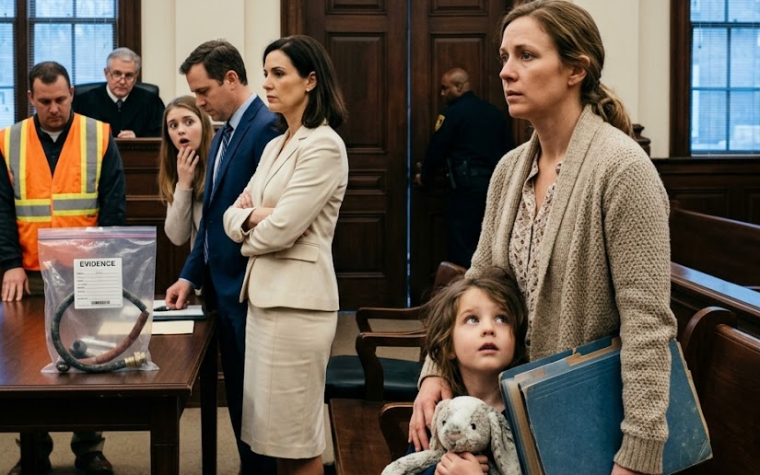
Under oath, Colette explained that she had signed my father’s bank revocation as a witness.
Diane later asked to borrow a copy, claiming the estate attorney needed it.
The signature on the Wyoming filing matched that witness page exactly, including a small streak where Colette’s pen had skipped.
Diane accused her of lying to protect me.
That accusation destroyed the last of her performance.
She stood at the counsel table, voice rising, and told the judge that Colette was weak, that I was vindictive, that my father had left everyone with chaos, and that she was the only person who had tried to hold the family together.
Judge Alderman let her speak longer than I expected.
Every sentence exposed another piece of the person she had hidden behind cream silk and gardenia perfume.
When she finally stopped, the judge turned to the medical evidence.
The note Diane described as a diagnosis of cognitive impairment was an emergency-room summary from five days after my father’s death.
I had gone seventy-two hours without sleep, forgotten the date during intake, and nearly fainted in a hospital corridor.
The complete record stated that I was oriented, coherent, and suffering from acute grief and dehydration.
Diane had submitted only the half-page containing the words “temporarily disoriented.”
The physician’s sworn clarification was already in the supplemental file.
Judge Alderman removed his glasses once more.
“The court finds no credible evidence that Miss Callaway lacks the capacity to manage her personal or financial affairs,” he said.
“The petition for temporary conservatorship is denied.”
Diane gripped the table.
The judge continued.
“The record instead raises substantial concerns regarding financial exploitation, falsified filings, interference with financial accounts, and misuse of estate assets.
The court is ordering the immediate preservation and temporary restraint of accounts connected to the identified entities.
The clerk will transmit the relevant materials to the appropriate investigative authorities.”
Curtis stared straight ahead.
“The court will also review counsel’s representations concerning the source and purpose of his retainer.”
That was when Curtis pushed his chair back and asked for permission to withdraw from representing Diane.
The judge did not answer immediately.
He looked first at Diane, then at the tissue crushed beneath her fingers.
“Mrs.
Callaway,” he said, “care is not the same thing as control.
This court will not confuse the two.”
The hearing ended without applause.
Real reversals rarely sound the way they do in movies.
Chairs scrape.
Clerks collect exhibits.
People avoid one another’s eyes.
Diane remained seated while the bailiff explained the preservation order.
Her Cartier watch had slipped fully into view.
She covered it with her other hand, as though even that small flash of luxury had become evidence.
In the hallway, Aunt Colette approached me.
“I believed her,” she said.
“I watched you sit there, and I believed her.”
I could have comforted her.
That was what the old version of me would have done—made another person’s shame easier to carry.
Instead, I said, “Then help tell the truth.”
She did.
Over the following months, Colette turned over emails, calendars, and copies of documents Diane had asked her to witness.
She testified about the revocation letter and the signature page Diane borrowed.
Her daughters found messages in which Diane coached family members to describe me as confused without ever asking whether they had observed confusion themselves.
The civil recovery took almost a year.
The escrow company returned the condominium deposit.
The brokerage account was frozen before most of the investments could be moved.
Other assets were sold under court supervision.
Of the $1.86 million traced through the Wyoming companies, the estate eventually recovered most of it, along with a judgment for the remaining balance and legal costs.
The Cartier watch appeared on an inventory of property surrendered toward restitution.
I did not ask to keep it.
It was sold.