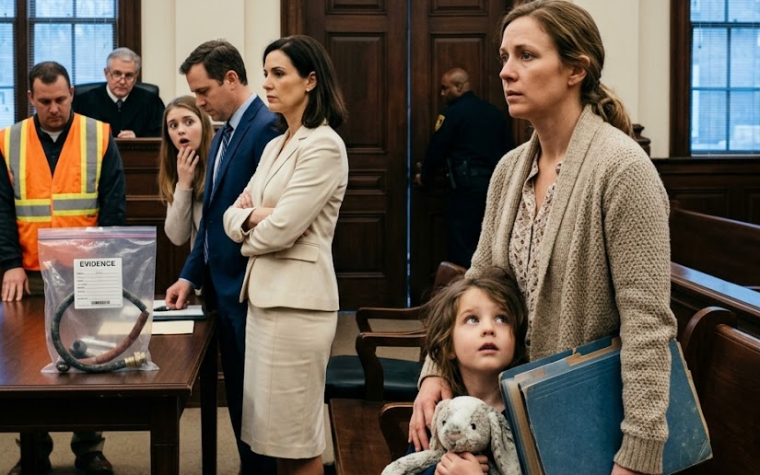
I looked around the room Thomas and I had paid for, maintained, and filled with fifty-three years of work.
My son stood beneath his father’s photograph asking me to protect him from the result of excluding me from a home I had financed and accounts I had unknowingly sustained.
“You will lose what you cannot afford,” I said.
“That is not everything.”
Genevieve picked up her handbag.
“We are leaving.”
Benjamin did not move.
She reached the doorway, then looked back at me.
“You have destroyed this family over one dinner.”
“No,” I said.
“The dinner showed me what had already happened.”
She left without another word.
Benjamin remained seated for several seconds.
Then he signed the acknowledgment Wesley placed before him.
His signature looked rushed and unfamiliar.
At the door, he paused.
“Did you ever love me without keeping score?”
The question nearly undid me.
I held the edge of the folder until my fingers stopped trembling.
“I loved you so much I refused to keep score,” I said.
“That is how the number became one hundred seventy-four.”
He looked down.
For once, I did not rescue him from the silence.
The bank’s review lasted six weeks.
Most payments had begun with my permission and expanded through years of carelessness, assumptions, and access I should have revoked long before.
Seven newer authorizations had been added without my direct approval.
Clara closed the pathways, changed every credential, and documented the disputed transfers.
I chose not to pursue a criminal complaint.
Wesley made it clear that the option existed if evidence showed deliberate deception, but I wanted boundaries, repayment, and truth—not a spectacle that would follow my granddaughter through school.
Benjamin signed a repayment agreement for the unauthorized transfers and the money directed into Kelley Strategic Holdings.
The business had no clients, no employees, and almost no remaining balance.
Genevieve canceled the country club membership within a week.
They refinanced the townhouse at a worse rate, sold one vehicle, and moved their daughter to a less expensive preschool the following term.
None of it was ruin.
It was simply the cost of their own life arriving at their own door.
Serena came to see me after Wesley called her with my permission.
She stood in my kitchen, read the payment list, and cried—not because of the money, but because she had suspected for years that Benjamin was leaning on me and had accepted my repeated assurances that everything was fine.
“You always protected him,” she said.
“I thought I was protecting the family.”
“You were protecting the secret.”
She was right.
My granddaughter visited the next Sunday.
Benjamin brought her himself but did not come inside.
She carried a paper bag filled with cookies she had helped bake.
“Daddy said you are not paying for things anymore,” she told me at the kitchen table.
“That is true.”
“Are you mad at me?”
I took her hand.
“Never.”
“Are you mad at Daddy?”
“I am disappointed in some choices he made.
Adults can love each other and still require better choices.”
She considered that while breaking a cookie in half.
“Mom says families help each other.”
“They do.”
“Then why are you not helping?”