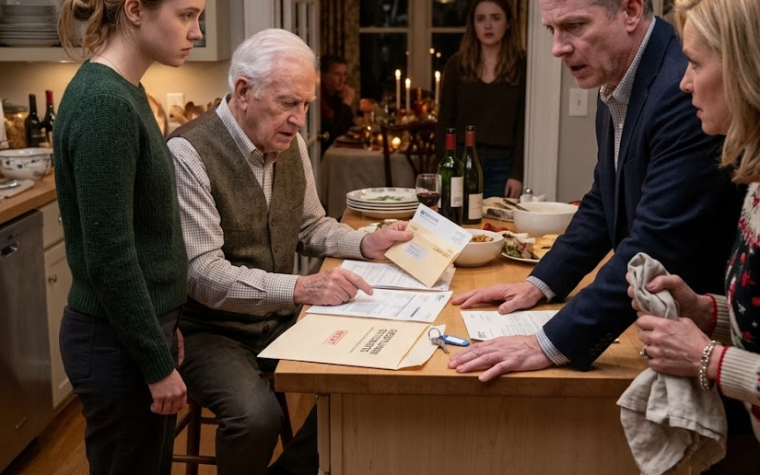
“Read it.”
I hesitated, then picked it up.
Diane had not written about money.
She wrote about time.
She told Darnell she loved him.
She told him she knew adulthood pulled people in different directions and that she had never expected him to build his whole life around his parents.
But she also wrote that love could not survive indefinitely on intentions.
Calls mattered.
Showing up mattered.
Sitting beside someone when there was nothing useful to say mattered.
Near the bottom she had written a sentence that made Darnell cover his face with one hand.
She told him she hoped he would never confuse convenience with love.
There was no accusation about a funeral.
She had written the letter before the funeral existed.
That made it worse.
She had seen the distance before I had.
Darnell cried then.
Not loudly.
He bent forward over the kitchen table where his mother had served him breakfast before school, helped him fill out college forms, and once stayed awake until two in the morning helping him rebuild a science project he had dropped on the basement stairs.
“I should’ve come,” he said.
I did not rescue him from the sentence.
“Yes.”
He nodded.
“I thought there would be more time.”
“So did I.”
He wiped his face.
“The trip seemed important.”
I looked toward Diane’s empty chair.
“Most things do until they aren’t.”
For months afterward, the estate documents remained exactly as Diane had written them.
Darnell asked Harold questions, but he never challenged the papers in court.
Maybe Harold’s explanation convinced him.
Maybe Diane’s letter did.
Maybe he finally understood that fighting her last decisions would not bring her back or erase the choice he had already made.
His wife stopped discussing the house with me.
The designer handbag never crossed my doorway again.
Darnell did.
At first, his visits were awkward.
He would sit in the living room and glance toward places where his mother should have been.
Sometimes he brought groceries I had not asked for.
Sometimes he fixed small things around the house that did not need fixing urgently.
Once he spent nearly an hour tightening a loose cabinet hinge because neither of us knew how to begin talking about Diane.
Eventually we did.
Not all at once.
Grief rarely opens like a door.
It leaks through cracks.
A photograph.
A recipe card.
A song from the radio.
The dented Thanksgiving pie pan Diane had owned since before we were married.
The first Thanksgiving without her, Darnell found that pan in the bottom cabinet.
He held it up.
“You keeping this?”
I looked at him.
“Your mother kept it forty years.
What do you think?”