The icing had shifted slightly during the drive.
One corner of the box was dented.
It was no longer the elegant surprise I had imagined when I bought it that morning.
Mom laughed when she saw me examining it.
It was the first laugh I had heard from her all day.
“Well,” she said, “I suppose we should still have cake.”
Dad looked at the clock.
“Fifty years and we almost got evicted from our own anniversary.”
Mom gave him a look.
“Don’t make that the toast.”
He smiled.
The shaking in his hands had stopped.
We ate cake at the kitchen counter because the dining room still had several of Julia’s discarded packing materials near the wall.
Dad cut pieces that were much too large.
Mom complained about his portions and ate every bite.
The ocean outside darkened from blue to gray.
Nothing about the evening matched the celebration I had planned.
It was better in one important way.
The house finally belonged emotionally to the people it had always been meant to protect.
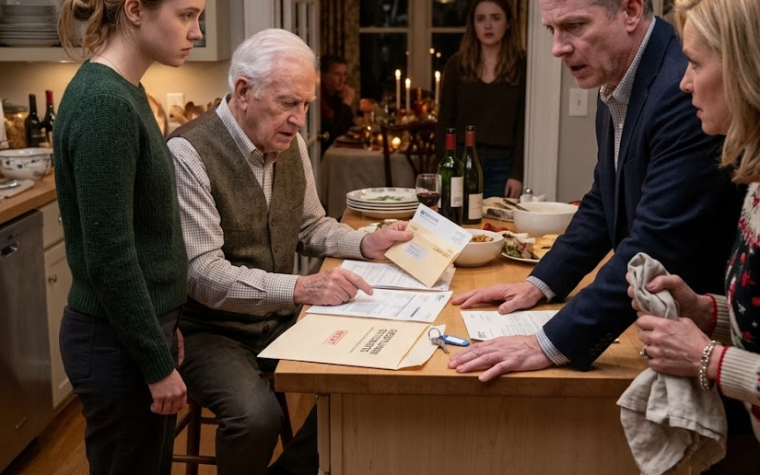
Before I left, I walked Mom and Dad through the trust paperwork again—not because they had done anything wrong, but because I wanted them to understand every protection I had put in place.
Dad listened carefully.
Mom kept one hand on the folder.
“So nobody can just decide this is theirs?” she asked.
“No.”
“And nobody can tell us which room we get?”
“No.”
Dad glanced toward the stairs.
“I like the upstairs room.”
“Then use the upstairs room.”
Mom smiled.
I handed Dad the folder.
This time, I did not keep it in my car.
It belonged with them.
At the door, Dad hugged me longer than usual.
“I’m sorry your surprise got ruined,” he said.
I looked past him at the living room, the open cake box, Mom folding tissue paper on the counter, and the dark water beyond the windows.
“It didn’t.”
He raised an eyebrow.
I meant it.
The point of the house had never been the blue siding, the ocean view, the prepaid fees, or even the price.
The point was that after fifty years of work and sacrifice, my parents could close a door and know nobody else had the right to order them out.
Dad looked at the lock he had turned himself.
Then he smiled.
For most of my life, I thought being the fixer meant making every problem disappear before anyone else had to feel it.
That afternoon taught me something different.
Some problems should not be absorbed.
Some demands should not be funded.
Some doors should simply be closed.
As I walked toward my car, I heard the lock click behind me again.
This time, my father was not being pushed toward the door.
He was standing safely on the other side of it, in his own home.