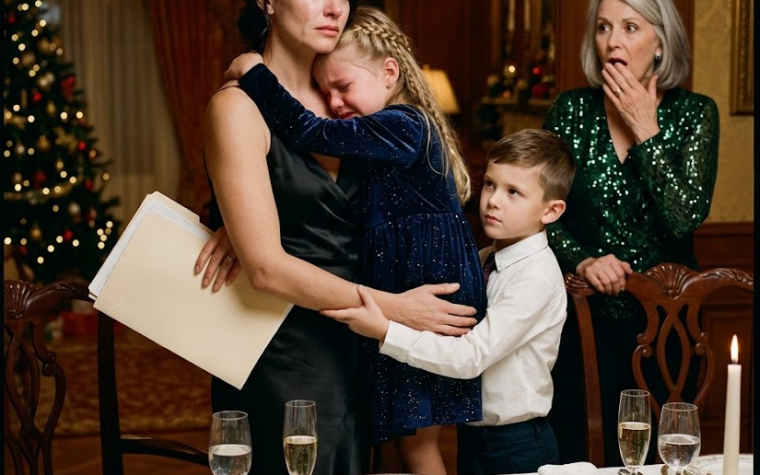
“Lauren decided a seven-year-old had to lose her ability to see clearly because she glanced at a phone.
Then two grandparents watched her get punished until her hands were red.
The glasses are evidence of what happened.
They are not what this is about.”
My mother started crying.
I did not soften the facts to make the crying stop.
For years, that had been our family’s favorite trick.
Whoever became most uncomfortable first got rescued, and whoever had been hurt was expected to make things easier for everyone else.
Grace was not going to inherit that habit from me.
After we hung up, I took her to have the damaged glasses examined.
The person helping us turned the frame over in both hands.
“This took pressure,” she said carefully.
I asked her to note the condition in Grace’s record and give me the replacement estimate.
She did.
That gave me something Lauren had not expected.
A neutral description.
Not my anger.
Not Grace’s fear.
A damaged medical device, seen and recorded by someone outside the family argument.
From there, I contacted the appropriate child-safety intake line and explained exactly what had happened.
I did not demand that anyone be arrested.
I did not predict what authorities would decide.
I simply reported the facts: Grace’s age, her visual impairment, the deliberate destruction of her glasses, the repeated cleaning, the condition of her hands, the adults present, and the statements I had documented.
The person taking the information asked calm, specific questions.
Was Grace safe now?
Yes.
Did Lauren live with her?
No.
Would Lauren have unsupervised access to her again?
No.
That answer came easily.
Then I made several other changes.
My parents were removed from the list of people who could pick Grace up without calling me first.
Lauren was removed completely.
I notified the people responsible for Grace during the day that nobody outside the updated list had permission to take her anywhere.
I put the damaged glasses, the replacement estimate, my photographs, and my notes together in one folder.
Then I waited.
Lauren called seven times before noon.
I answered once.
“You reported me?” she demanded.
“I reported what happened.”
“I am your sister.”
“Grace is my daughter.”
“You know I would never hurt her.”
I looked down at the photograph of Grace’s hands.
“You’ve already admitted you stepped on the glasses and made her clean repeatedly.”
“That is not hurting her.”
There was the problem, spoken more clearly than I ever could have explained it.
Lauren genuinely believed that because she had not done the worst thing imaginable, whatever she had done should be acceptable.
“She told you she couldn’t see,” I said.
Lauren stopped talking.
“Didn’t she?”
Another pause.
“She was being dramatic.”
“She is visually impaired.”
“She has backup glasses.”