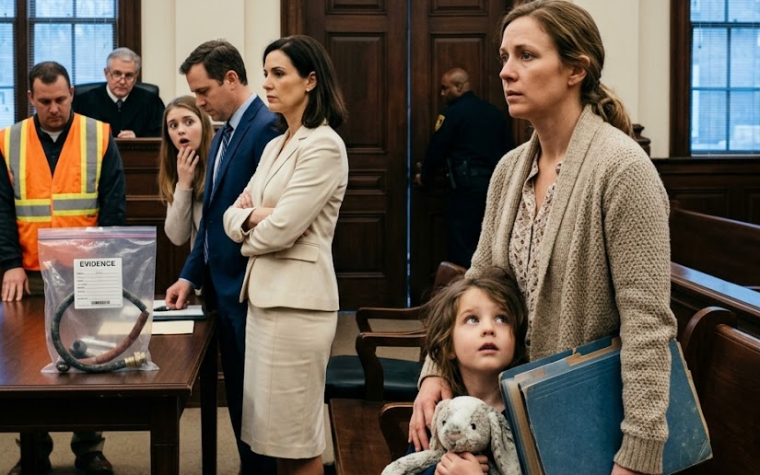
“Our security system recorded everything,” she said.
James looked toward the dark camera dome mounted above the fitting rooms.
For the first time, his fear became visible.
It appeared in the way his jaw shifted and in the sudden sheen of sweat above his collar.
He had spent years controlling rooms by controlling the people inside them.
A camera could not be intimidated, flattered, or threatened into forgetting.
“That footage belongs to the store,” he said.
“You are not authorized to release it.”
The manager squared her shoulders.
“The police can request it.”
“My attorneys will shut this place down.”
She flinched, but she did not retreat.
My brother glanced toward my handbag on the floor.
“Sarah, is that yours?”
I nodded.
James’s attention snapped back to it.
“What is in that bag?” he demanded again.
The question frightened me more than his shouting.
It confirmed that he had noticed my behavior before the officer entered.
For months, he had searched my phone, read my messages, and demanded receipts for anything I bought.
He believed privacy itself was evidence of betrayal.
My brother asked whether I wanted him to retrieve the bag.
I said yes.
He picked it up without opening it and handed it to me.
James stepped forward.
My brother moved once, placing his body between us, and James stopped.
I reached into the bag and removed a thick envelope.
It was not a dramatic secret capable of destroying him with a single page.
It was something more dangerous to a man like James: a record.
Inside were printed photographs of older bruises, copies of messages in which he threatened to cut off my money, and a list of dates I had written down after each incident.
There were also two memory cards containing voicemails I had saved before he could delete them from my phone.
I had started collecting the evidence three months earlier.
At first, I did not collect it because I planned to leave.
I collected it because James was so skilled at denying what had happened that I had begun doubting my own memory.
After every outburst, he became gentle.
He ordered flowers, cooked dinner, and spoke softly to the baby through my stomach.
Then he explained that I had provoked him, misunderstood him, or imagined the worst part.
The folder reminded me that I had not imagined anything.
James stared at the envelope.
“You stole private communications,” he said.
“They were sent to me.”
“You have no right to use them against me.”
The socialite laughed once, without humor.
“She has no right to keep messages you sent her?”
James pointed at her.
“Stay out of this.”
The woman lifted her phone.
“I recorded the last minute,” she said.
“Including that threat.”
She had begun recording after dropping the vase.
Her hands were still trembling, but the phone remained raised.
James’s face changed again.
The polished husband disappeared.
What remained was the man I knew at home—the one who became most dangerous when control slipped beyond his reach.
“You think a blurry video proves anything?” he shouted.
“She staged this.