On-screen, Derek wrapped the leather around his fist and smiled.
“Now that the honeymoon is over, it’s time you learned the rules of being a wife.”
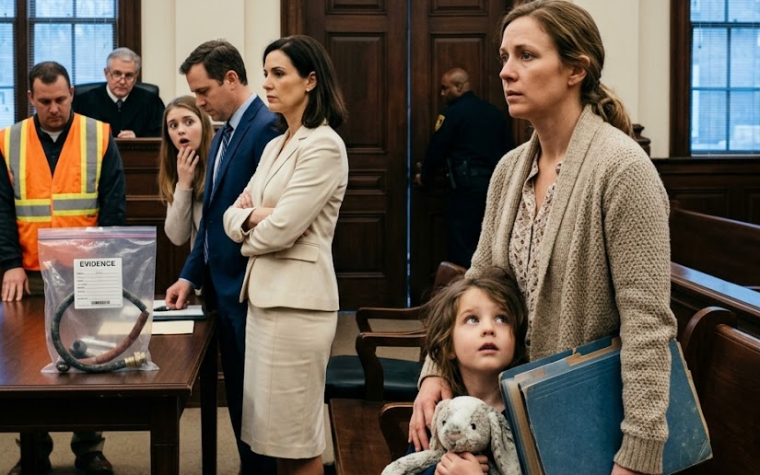
The courtroom became so quiet I could hear the ventilation system above us.
Derek stared at the table.
His mother stared at the judge.
The video showed me remove my travel shirt and reveal the boxing clothes underneath.
It showed me retrieve the red gloves from my suitcase.
A few people glanced toward the glove resting beside me in court.
Then Derek swung.
The belt missed my face by less than a foot.
I moved outside its reach, struck his chest once, and stepped back.
He charged again.
The footage showed the entire sequence: his raised arm, my controlled pivot, his fall, and the distance I immediately placed between us.
There was no wild attack.
No beating.
No loss of control.
I had used exactly enough force to stop him.
My lawyer froze the frame showing me several feet away while Derek remained on the floor.
“She did not pursue him,” he said.
“She did not strike him after he fell.
She called emergency services and ordered him to leave.”
Derek’s lawyer rose again.
“My client believed she was threatening him with her professional fighting ability.”
The judge looked at the frozen image of Derek holding the belt.
“He appears to be the only person holding a weapon.”
Derek’s lawyer sat down.
The footage resumed.
“You hit me,” Derek said on-screen.
“I’ll tell everyone you attacked me.”
Then the recording captured my answer.
“That would make an interesting story.”
I saw the exact moment he looked toward the smoke detector.
His confidence vanished.
He called his mother almost immediately afterward.
The courtroom heard the conversation again, this time synchronized with the video.
They watched Derek pace while his mother told him to follow the plan.
They watched me remain near the door, one glove still on my hand, recording the call without provoking him.
When his mother mentioned the signature, Derek nodded.
That small nod mattered.
It destroyed his claim that he had not understood what she was talking about.
My lawyer stopped the footage.
“There is more,” he said.
Derek’s mother looked at him sharply.
From beneath the table, my lawyer lifted a navy folder sealed inside a clear evidence sleeve.
I recognized it immediately.
The officers had found it inside Derek’s carry-on suitcase after they separated us that night.
He had packed it beneath two folded shirts and a brochure from our hotel in Hawaii.
When the officer asked whether the folder belonged to me, I said I had never seen it before.
They photographed it where it was found and instructed me not to open it until my lawyer could be present.
The following morning, my lawyer and I examined the contents together.
Inside were transfer documents for three of the properties my father had left me.
The pages were marked with small removable tabs showing exactly where I was expected to sign.
There was also a document giving Derek broad authority to manage, refinance, lease, and sell property on my behalf.
The language was dense enough to look routine to anyone who did not read legal documents carefully.
Derek had planned to present the papers as ordinary marriage and tax forms.
My lawyer removed a certified copy from his file and handed it to the judge.