“Emma Carter is alive,” the man said into his headset.
“Do not alert the husband.”
Michael’s name cut through the fog in my mind more sharply than the pain.
The stranger opened a black medical case and fitted an oxygen mask over my face.
I fought him until he lowered his voice.
“High-altitude rescue,” he said.
“You and your baby are our only concern.”
The helicopter hovered above the ledge, its searchlight turning the snow around us into a white, spinning wall.
The rescuer examined my wrist, ribs, pupils, and abdomen without moving me more than necessary.
When he touched the blood beneath my coat, his expression tightened.
“How long ago did you fall?”
I tried to answer, but my teeth would not stop chattering.
“My husband,” I managed.
“Michael Carter.
Ashley.
They pushed me.”
His gaze shifted toward the ridge.
“Did they know you survived?”
“No.”
“Keep it that way.”
He secured my neck, wrapped thermal blankets around my body, and placed a monitor against my belly.
Static crackled from the small speaker.
Then a rapid heartbeat filled the canyon.
My son was still alive.
I sobbed into the oxygen mask—not because I felt safe, but because that sound was the first proof that Michael had failed.
The rescuer signaled upward.
A cable descended, and he fastened both of us into a rescue harness.
As the winch lifted us from the ledge, I looked down at the broken red device half buried in the snow.
“Take that,” I whispered.
He followed my gaze.
“The blinking thing?”
“It’s bait.”
He retrieved it before we rose into the storm.
Inside the helicopter, the crew cut open my coat and stabilized my injuries.
No one mentioned Michael again, but the rescuer placed the crushed device in an evidence bag.
Another crew member photographed the blood trail, the outcrop, and the ledge through the open door before the mountain disappeared beneath the clouds.
I drifted in and out of consciousness during the flight.
Each time I woke, I asked the same question.
“My baby?”
“Heartbeat is strong,” someone answered.
At the hospital, surgeons repaired my wrist and treated internal bleeding, fractured ribs, and severe hypothermia.
My left leg was badly damaged but not beyond saving.
The fall had triggered contractions, and for several hours the doctors feared my son would be born too early.
I remember bright lights, masked faces, and one nurse telling me to keep breathing.
I remember gripping the sheet with my uninjured hand and thinking of Michael taking my ring.
“You won’t be needing this anymore.”
He had said it with such certainty.
By morning, the contractions had slowed.
My son remained inside me, his heartbeat steady beneath the monitors.
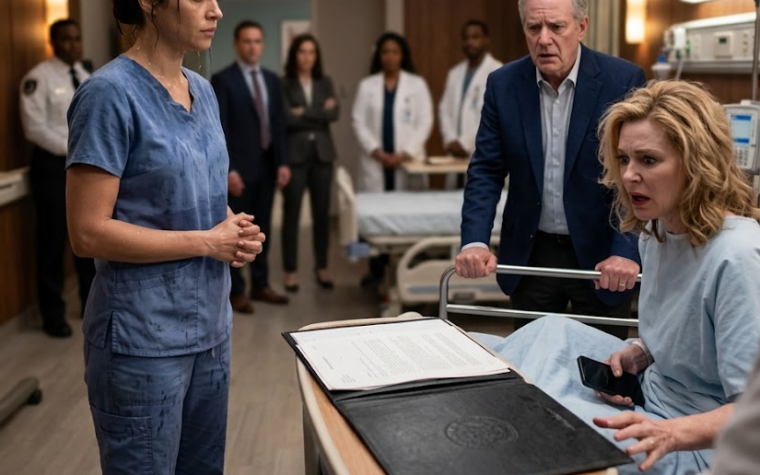
A law-enforcement investigator came to my room after the doctors declared me stable enough to speak.
He did not ask whether I was certain Michael had pushed me.
He asked me to describe every movement, every word, and every object on the ridge.
I told him about Michael removing my ring.
I told him about Ashley smashing the satellite radio.
I repeated Michael’s words about my mother dying at Devil’s Cradle and his plan to call my death another accident.
Finally, I described the predator lure.