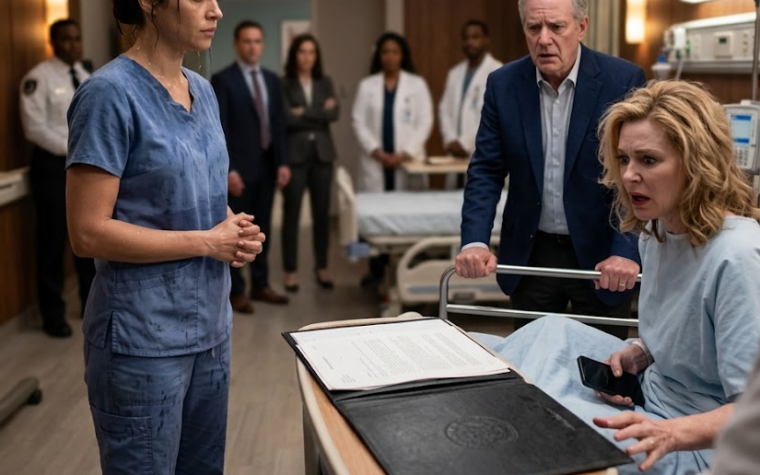
My father asked whether I wanted to see Michael brought in.
I said no.
I had already watched him at the cliff.
I had watched him at my funeral.
I did not need another image of his face.
Months later, when the case moved forward, I gave my statement in person.
Michael finally saw me alive.
The reaction was smaller than I expected.
No dramatic collapse.
No confession.
He simply went pale.
For perhaps the first time since I had known him, Michael Carter had nothing prepared to say.
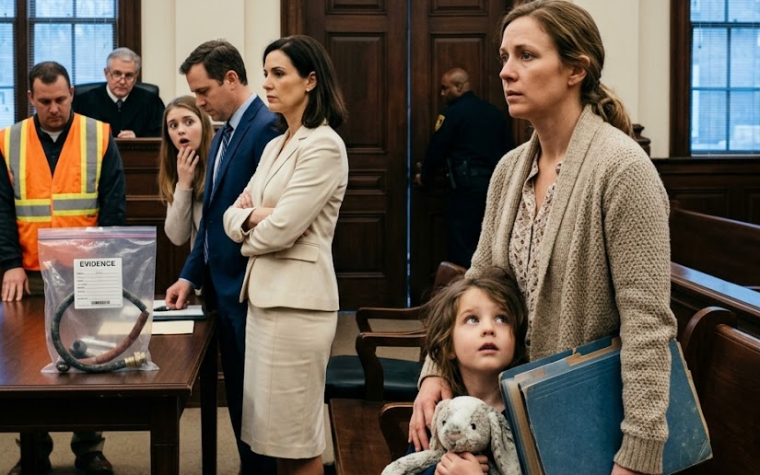
His lawyer tried to challenge my memory because of the trauma and cold.
Then the evidence was presented piece by piece.
The insurance documents.
The travel timeline.
The lodge records.
The absence of an emergency call.
Ashley’s statement.
The physical evidence from the overlook.
Michael’s own words after he believed both his wife and unborn son were dead.
The story he had built for himself collapsed under its own weight.
He had believed the mountain would erase evidence.
Instead, it preserved the one witness he could not explain away.
Me.
The insurance company denied the claim.
The money Michael had killed for never reached him.
His freedom did not last either.
The case ended with consequences that matched the seriousness of what he had done: attempting to kill his pregnant wife for financial gain and leaving her in a winter storm while conspiring to profit from her presumed death.
Ashley faced consequences for her own participation and the lies she told afterward.
I did not celebrate either outcome.
There are things that happen to you that cannot be balanced by someone else’s punishment.
A conviction could not erase the sensation of falling.
It could not make me forget Michael smiling over the edge.
It could not return the version of my marriage I once believed was real.
But it gave me something quieter.
Finality.
My son came home from the hospital healthy enough to fill every room with noise.
Sometimes I would hold him against my chest and remember that tiny kick beneath the snow.
He had no idea what that movement had done.
It had kept me awake.
It had given me one more reason to breathe.
One more minute became another, and another, until a black helicopter appeared through the storm.
My father remained in our lives.
Our relationship did not become simple just because he rescued me.
There were years between us, questions that needed answers, and old wounds that belonged to more than one person.
But he never asked me to pretend those years had not happened.
He showed up.
Again and again.
Eventually, he gave me a copy of the same photograph my mother had once hidden.
This time nobody snatched it from my hands.
I studied the younger man in the picture, then looked across the room at the silver-haired grandfather holding my son.
For most of my life, that photograph had represented abandonment.
Now it represented something unfinished.
Michael had taken me to the mountain because he believed isolation made me powerless.
He thought there would be no witness, no rescue, no voice left to contradict him.