I almost admired how quickly he could change masks.
A few minutes earlier I was unstable.
Then I owed his family for my security.
Now he was patient and reasonable.
“We can all go home,” he continued.
“Rest.
Talk privately.”
“No.”
Caleb stared at me.
“You’re choosing him over me?”
I shook my head.
“I’m choosing Eli and me over this.”
His face twisted.
“You think you can just take my son?”
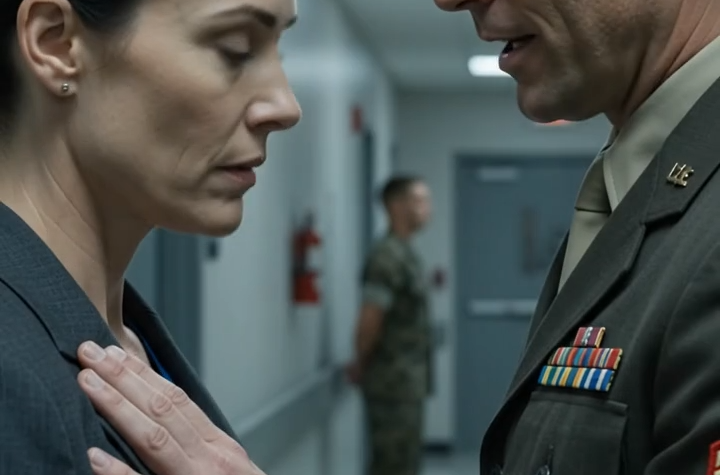
The nurse immediately stepped toward the door and called for security.
Martin closed his eyes.
That was when I saw it.
Not guilt.
Recognition.
He had seen this moment before, long before I was born: a man he had trained to equate control with respect losing control because a witness refused to be quiet.
Ray stood beside my bed.
“You taught him badly,” he said.
Martin opened his eyes.
“Do not blame me for my adult son’s marriage.”
“I don’t,” Ray said.
“Caleb is responsible for what Caleb did.”
Caleb looked at his father as if waiting for him to fix everything.
Martin could not.
Hospital security arrived and Caleb was required to leave the room.
He protested until the nurse repeated that I had requested he be removed.
Then he looked at Martin.
“Do something.”
Martin said nothing.
Caleb was escorted out.
Martin remained for one extra second.
His eyes went to Ray’s forearm.
“You have been waiting for this,” he said bitterly.
Ray shook his head.
“No.
I hoped never to see you again.”
Martin looked at me.
“You have no idea how difficult life becomes when families turn against each other.”
I held his gaze.
“You’re still doing it.”
“What?”
“Making fear sound like advice.”
For the first time, Martin looked old.
He left without another word.
The next several hours were not dramatic in the way Caleb would later describe them.
There was no triumphant speech.
No applause.
No instant justice.
There were forms.
There were photographs.
There were quiet questions I had to answer more than once.
There was a safety plan for leaving the hospital.