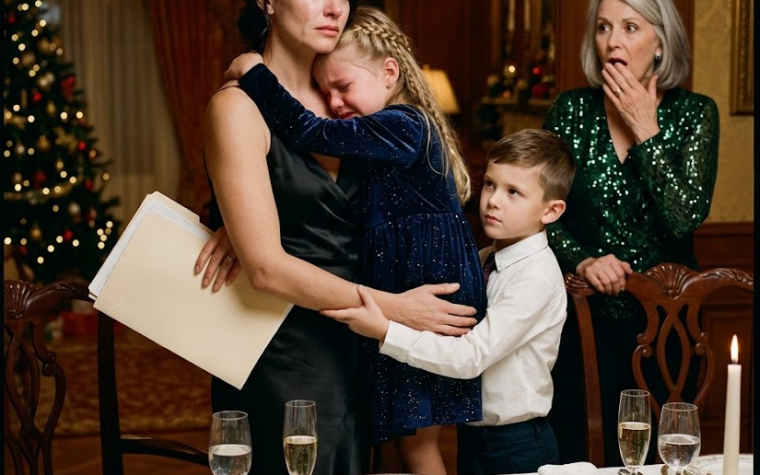
“You still don’t know that.”
Emily reached into the folder and removed one final sealed envelope.
“The hospital ordered genetic screening because one twin had a blood abnormality,” she said.
“They compared the babies’ samples with a stored sample Michael gave during our fertility testing two years ago.
I signed the release this morning.”
She placed the envelope in front of him.
Michael did not open it immediately.
He looked at the two infants sleeping in a double stroller near the wall.
In the rush of the meeting, he had barely allowed himself to look at them.
One had a tiny fist resting against his cheek.
The other slept with his lower lip tucked inward, exactly as Michael’s mother said he had slept as a baby.
He opened the envelope.
The probability of paternity exceeded 99.99 percent for both children.
Michael closed his eyes.
For one second, joy tried to rise inside him.
It collided with the knowledge that his sons had spent their first weeks in a church shelter while he chose furniture with Ashley for a house Emily had once helped him design.
“What are their names?” he asked.
Emily hesitated.
“Samuel and Daniel.”
His father’s first and middle names.
Michael covered his mouth.
Ashley stared at Emily with open hatred.
“You named them that deliberately.”
“Yes,” Emily said.
“Because despite everything I was told, I wanted them to know where they came from.”
The hospital’s attorneys ended the meeting soon afterward.
Ashley was escorted to a separate office, where investigators requested a formal statement.
She refused to give one without an attorney.
By evening, the engagement ring Michael had given her lay sealed in an evidence bag with other property recovered from his company office.
A search warrant later uncovered copies of Emily’s identification, drafts of the forged no-contact authorization, and photographs of Michael’s signature practiced repeatedly on a yellow legal pad.
The financial scheme was more elaborate than Michael had imagined.
Ashley had created the false account months before the divorce.
She routed company money through two inactive vendors, then transferred it into an account bearing Emily’s maiden name.
She sent Michael the motel photographs after following Emily to her meeting with the bank investigator.
Cropped tightly, the pictures looked intimate.
The uncropped versions, recovered from Ashley’s cloud storage, showed the bank’s fraud department logo on the man’s folder.
Ashley had not acted in a moment of jealousy.
She had built the lie piece by piece.
When Emily became pregnant, the plan grew crueler.
Ashley intercepted letters at Michael’s office, blocked numbers on his phone while pretending to install security software, and convinced hospital staff that she was carrying out instructions from Michael’s attorneys.
Each time Emily found another way to reach him, Ashley closed it.
The criminal case took months.
Prosecutors charged Ashley with offenses connected to fraud, identity theft, forgery, and unlawful access to protected records.
The hospital also dismissed an employee who had accepted repeated changes without independently verifying them and adopted new safeguards for disputed emergency-contact requests.
None of it repaired what Emily had endured.
Michael learned that on the first morning after the meeting.
He arrived at the church shelter carrying diapers, formula, clothing, and two expensive infant car seats.
Emily met him on the porch and refused to let him carry anything inside.
“I don’t need a rescue performance,” she said.
“I’m trying to help.”
“You are trying to feel better.”
The accuracy of it silenced him.
Emily shifted Daniel against her shoulder.
“Your lawyers froze our joint accounts when you accused me of theft.
I lost the apartment because I couldn’t pay the deposit.
My insurance ended during the divorce.