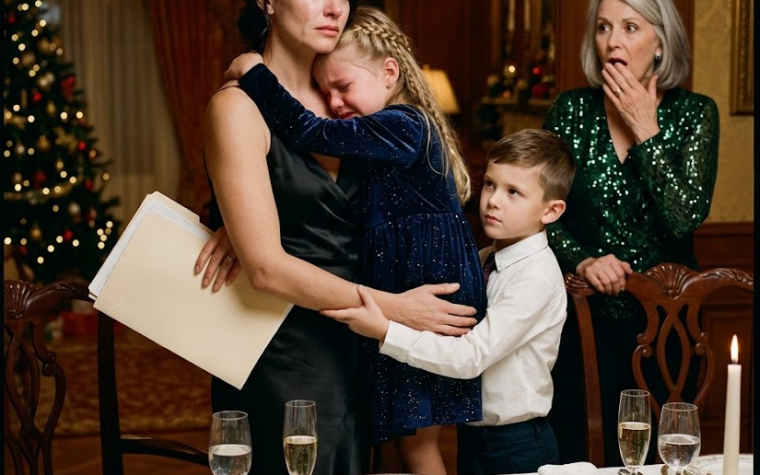
She presented the earlier messages, the voicemail, and the medical documents showing exactly what the $65,000 was intended to cover.
She explained that I had repeatedly refused the transfer before the meeting and that my parents had continued pressuring me.
Jackson’s gambling debt was acknowledged, but it did not excuse anything.
His creditors had no legal right to my savings.
My parents had no authority over the protected medical account.
The supposed family emergency did not transform my surgery fund into Jackson’s property.
When Dad suggested I had exaggerated my condition, my attorney submitted a statement from my oncology team confirming the diagnosis, the urgency of the surgery, and the expected recovery costs.
Mom began crying.
Jackson stared at his watch.
Dad finally looked at me.
For the first time in my life, I did not lower my eyes.
The protection order remained in place.
The assault case continued, and Dad eventually accepted a plea rather than force the complete recording through a trial.
The court imposed criminal penalties, mandatory counseling, and strict no-contact conditions.
Mom was not charged with the physical attack, but her words on the recording followed her.
She could no longer pretend she had tried to save me.
Any contact had to go through my attorney, and every message she sent became evidence of whether she respected the order.
Jackson received none of my money.
He sold the $900 watch first.
Then he sold his gaming equipment and his car.
He met with a lawyer about his debts and, for the first time, faced consequences that could not be transferred to me.
He sent one message through my attorney.
You ruined my life.
I read it twice before replying.
No.
I stopped letting you use mine.
The following week, I entered the hospital for surgery with the full $65,000 still protected.
The money paid for the procedure, medication, transportation, and the apartment expenses I would not have been able to cover while recovering.
There was no miracle waiting after the operation.
Healing was slow.
Some mornings, standing long enough to make tea felt impossible.
I still worried about test results.
I still woke from dreams in which Dad’s hand was around my throat and Mom was telling me not to resist.
But the door to my apartment stayed locked.
My phone stayed quiet.
And every day I recovered belonged to me.
Several months later, my attorney returned the original envelope.
The documents inside were no longer urgent.
The surgery had been completed, the bills had been paid, and enough remained to support the rest of my recovery.
Tucked behind the account statements was a copy of the Disney World photograph that had hung in my parents’ kitchen.
An officer had photographed the room after the assault.
In the image, the frame was crooked and the glass was cracked directly between Jackson and me.
For a long time, I studied the smiling faces.
I had once believed that picture represented the family I had lost.
Eventually, I understood that it represented something else: the image we had all been trained to protect, no matter what happened behind closed doors.
I put the photograph through a shredder.
Then I placed my medical records, the court order, and the final account statement inside a new folder.
Not because I wanted to live surrounded by evidence, but because proof had given me back the one thing my father believed he could take whenever he wanted.
My own voice.
The $65,000 saved more than my treatment.
It paid for the months in which I learned that survival was not selfish, boundaries were not betrayal, and blood did not give anyone ownership of my future.
My father had told me Jackson needed the money more than I needed my life.
In the end, he was wrong about both.
Jackson did not need my money.
He needed consequences.
And my life had never required my family’s permission to matter.