“You said the money was available.”
“It is available,” I said.
“For my surgery.”
His misery disappeared.
What remained was rage.
“You let us sit here begging when you already knew you couldn’t transfer it?”
“I told you no before I came.
You demanded this meeting anyway.”
Dad pointed toward the door.
“Get out.”
The command almost made me laugh.
Seconds earlier, he had stopped me from leaving.
Now that consequences were approaching, he wanted the evidence gone.
Red and blue light flashed across the kitchen wall.
My attorney told me to place the phone on the floor where it could keep recording without being taken.
I lowered it carefully, then slid down the wall beside it.
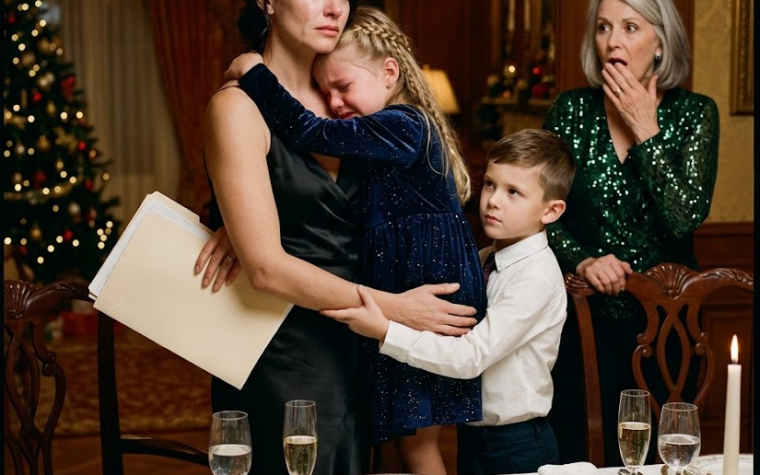
When the officers entered, Dad stood in the center of the kitchen with his hands raised and an expression of injured dignity.
Mom cried immediately.
Jackson said nothing.
Dad told them I had become hysterical because my treatment was affecting my mind.
He said he had only restrained me to prevent me from hurting myself.
Then one officer noticed the marks forming around my throat and the swelling near my temple.
The other noticed the overturned chair, the cracked photograph, and my mother still gripping the strap of my bag.
My attorney remained on the line.
“She has an uninterrupted audio recording beginning twenty-three minutes before the assault,” she said.
“I can provide a secure copy.”
Dad’s story collapsed before he finished telling it.
The officers separated us.
One led Dad toward the living room.
Another asked Mom and Jackson to remain at the table.
I was taken outside, wrapped in a blanket, and examined by paramedics beneath the porch light.
I kept waiting for guilt to overwhelm me.
Instead, I felt something unfamiliar.
Relief.
At the hospital, doctors examined my head and throat.
The injuries were painful but did not prevent the surgery already scheduled for the following week.
I had been terrified that Dad’s attack would cost me the very treatment I had fought to protect.
My attorney arrived before midnight carrying a folder thick with printed messages, account records, and copies of the documents I had given her.
She placed it beside my hospital bed.
“You did exactly what we discussed,” she said.
“I almost didn’t press the button.”
“But you did.”
I looked toward the dark window.
“I knew he might threaten me.
I didn’t think he would actually try to kill me.”
She did not soften the truth.
“He believed fear would give him control.
The recording shows that clearly.”
The next morning, she played a section for me.
My father’s voice filled the hospital room.
Your brother needs that money more than you need your life.
Then came the scrape of my chair, the impact against the wall, my cry, and Mom shouting my name.
Not once did Mom tell him to stop.
Not once did Jackson move to help me.
Hearing it without the chaos around me was worse than remembering it.
The recording stripped away every excuse.