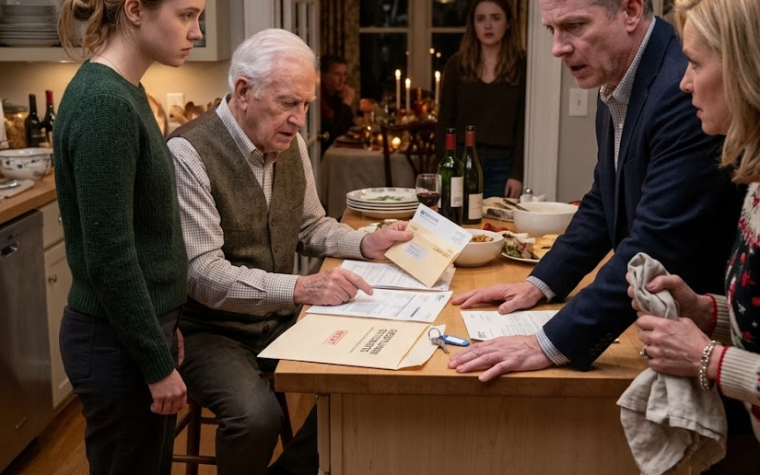
The sentence revealed more than he intended.
For eighteen months, my parents had praised my service in public while privately treating my absence as an opportunity.
They did not see the house as the home Hannah and I had built.
They saw it as an unused asset belonging to the son who always survived, always paid his bills, and never demanded anything from them.
Logan was the son they rescued.
I was the son they used to finance the rescue.
The secret was not merely that his company was failing.
Walter and Patricia had known for nearly a year.
They had guaranteed equipment leases, borrowed against their retirement account, and hidden collection letters from everyone.
By the time I came home, they were facing losses that could take their own house as well.
My property was their final escape route.
They had altered the power of attorney, transferred the deed to Walter, and prepared to borrow enough money to satisfy Logan’s most aggressive creditors.
Once the loan funded, they planned to tell me the transfer had been necessary and irreversible.
My father believed I would accept it because I had always been the calm one.
He mistook restraint for surrender.
An alert sounded on my phone.
Major Ruiz had sent confirmation that the lender’s fraud department had frozen the transaction.
No funds would be released.
The county recorder had also placed an emergency notice on the property record pending investigation.
Walter’s face changed.
“You had no right to interfere with that loan.”
“It is my house.”
“The deed says otherwise.”
“The deed is backed by an altered document.”
“Prove I altered it.”
A voice came from the doorway.
Our neighbor, Mrs.
Alvarez, stood behind one of the officers holding her tablet inside her coat to protect it from the snow.
She lived across the road and had seen the ambulance lights.
Her security camera faced our porch and driveway.
“I think this belongs to you,” she said.
The officer played the recording.
It showed Patricia taking Hannah’s phone.
It showed Patricia striking first.
It showed Logan carrying the infant carrier outside while Hannah pleaded with him to stop.
It showed Walter placing Hannah’s shoes just inside the doorway, where she could see them, before locking the door.
Then it showed all three of them returning to the living room as snow began covering the porch.
No one spoke while the recording played.
Patricia’s hand rose to her throat.
“That camera cannot hear what she said to me.”
“It heard you,” the officer replied.
The audio had captured my mother saying, “By the time Jake gets home, this will already belong to us.”
It had also captured Walter telling Logan that the loan would close before I arrived on Friday.
Logan stood abruptly.
“I didn’t know the storm would get that bad.”
My father turned on him.
“Sit down.”
“You said she would walk across the road.”
“Logan.”
“You said once the money cleared, Jake couldn’t undo it.”
The room seemed to shrink around my father.
Logan kept talking, not because he had suddenly found a conscience, but because he realized Walter intended to let him carry the blame.
He admitted Patricia had created the false messages using old emails from me.
He admitted he had provided copies of my identification from records I once gave his company for a veteran hiring application.
He said Walter had assembled the altered power of attorney using a scanned page from another document.
The notary section had been copied from paperwork in the original home-closing file.