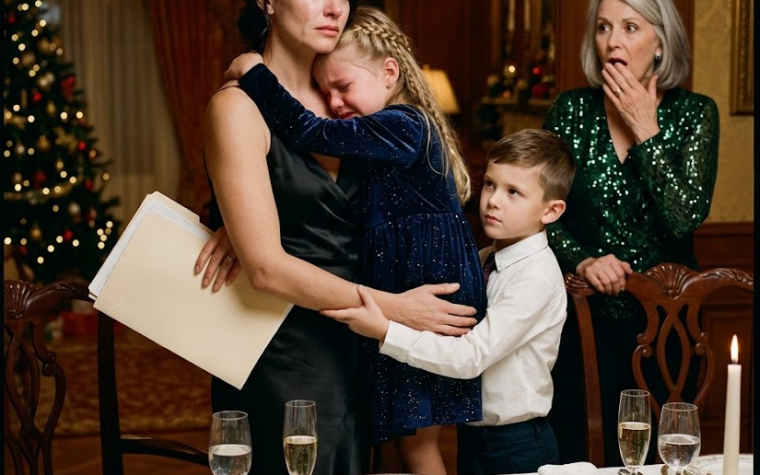
“And I was your daughter.”
That stopped him.
My mother began to cry without making a sound.
I picked up my handbag from the chair.
Admiral Whitaker asked me to remain available for a recorded statement.
I agreed.
Captain Hale escorted Mason through the side door, not in handcuffs and not under public spectacle, but without the medal, promotion, or applause he had expected.
Lindsay did not follow him.
My father stood beside the empty front row, surrounded by reserved signs that suddenly meant nothing.
He tried to speak twice.
No words came.
The review lasted six weeks.
Investigators established that Mason had found the mission identifier while processing restricted personnel-routing information.
He used fragments from archived logistics records to construct a version of events close enough to sound credible but vague enough to avoid naming protected personnel.
He had submitted the statement after learning that his command was seeking examples of overlooked operational initiative.
He had not invented NIGHT LANTERN.
He had simply placed himself inside it.
His advancement was withdrawn for that cycle.
The commendation recommendation was permanently canceled.
He received formal disciplinary action and was removed from duties involving protected records.
His career did not end in one dramatic afternoon, but the path he had designed for himself narrowed sharply.
That consequence mattered because it was believable.
No one destroyed him for being my brother.
He lost opportunities because he had signed his name beneath a lie.
Admiral Whitaker asked whether I wanted my role in NIGHT LANTERN publicly acknowledged after portions of the operation were declassified.
I declined a ceremony.
I accepted a corrected record.
The communications specialist who had actually transmitted the warning received the recognition Mason had tried to absorb.
His name remained private, but the citation reached him overseas.
That was enough for me.
My mother called three days after the review ended.
For the first minute, neither of us spoke.
Then she said, “I put your graduation picture back on the wall.”
I looked out through my apartment window at the harbor.
“Where did you find it?”
“I kept it in a box.”
The answer hurt more than if she had thrown it away.
She had saved proof that I existed, but only where my father could not see it.
“I should have stopped him,” she said.
“Yes.”
“I was afraid.”
“I know.”
She began to apologize again.
I interrupted gently.
“Being afraid explains silence.
It doesn’t erase what silence does.”
She accepted that without defending herself.
Two months later, she met me at a café near the water.
She arrived alone.
For the first time in my life, she spoke about my father without asking me to excuse him.
Mason wrote once.
His letter contained no accusation, no request for me to change my statement, and no claim that the punishment had been unfair.
He admitted that he had spent years resenting a life he believed I had chosen over the family.
When he discovered enough to understand what I had become, admiration had curdled into envy.
He had wanted our father to look at him the way senior officers apparently looked at me.
So he borrowed my mission.