Kloe was still in custody.
My bedroom looked exactly as I had left it, but it no longer felt like mine.
The graduation certificate they had never celebrated remained inside a plain folder beneath my bed.
I took it, my identification, my work clothes and the small box containing everything I could not replace.
Dad watched from the end of the hallway.
‘You are really doing this to us?’ he asked.
I zipped my bag.
‘You did it to yourselves.’
Mom began crying.
She said families forgave one another.
She said Kloe had been emotionally fragile.
She said Jake had broken her heart.
She said the iron had only touched me for a second.
She never said she was sorry for holding me still.
I left without arguing.
The legal process moved more slowly than the night of the assault, but it moved in a direction my parents could not control.
Kloe’s attorney initially claimed the injury was accidental.
That position weakened when the emergency recording was reviewed.
It weakened further when the body-camera footage captured Kloe saying I deserved it and explaining that Mom had restrained me because I fought back.
Mom’s explanation changed three times.
First, she said she had not touched me.
Then she said she had separated us.
Finally, when confronted with Kloe’s recorded statement, she said she had held me only because she feared I might hurt her precious angel.
The phrase sounded different in an interview room than it had in our house.
Dad insisted his threat had been figurative.
Prosecutors considered it alongside the voicemail ordering me to change my account and the message warning me not to return home.
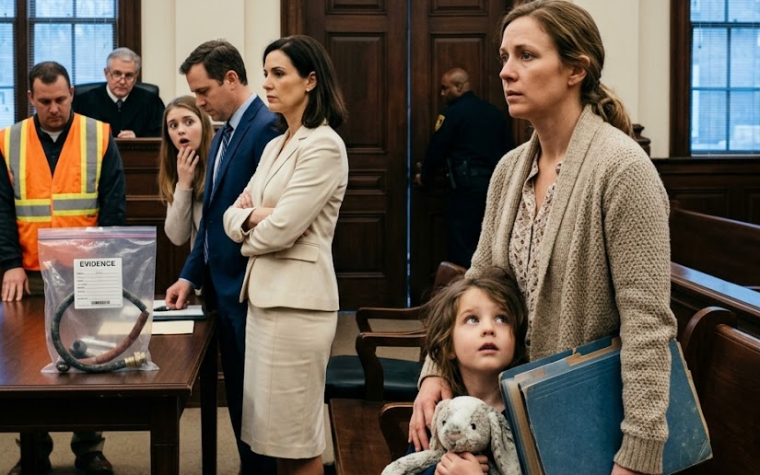
At a preliminary hearing, my family entered the courtroom together.
Kloe wore pale clothing and no makeup, carefully styled to look younger than twenty-two.
Mom kept one arm around her.
Dad scanned the room with the confidence of a man who still believed forceful certainty could become truth.
They did not look at me until the recording began.
My own scream filled the courtroom first.
Then my voice giving the address.
Then Mom shouting that it was a family misunderstanding.
Then Dad ordering me to hang up.
Finally, Kloe’s body-camera statement played clearly.
‘She deserved it.
Mom held her because Natasha always fights back.’
Kloe turned toward Mom.
Mom stared at Dad.
Dad’s face darkened as his recorded voice followed.
‘I told her she was lucky Kloe only burned her face.’
The confidence left all three of them at once.
That was the spectacular ending to Kloe’s golden-child protection.
It was not applause, revenge or a dramatic confession forced from them by me.
It was the simple arrival of a room where evidence mattered more than favoritism.
When the judge maintained the no-contact restrictions, Kloe began whispering furiously to Mom.
Outside the courtroom, the argument exploded.
Kloe blamed our parents for letting her talk to the police.
Mom blamed Dad for repeating the threat.
Dad blamed Kloe for losing control in the first place.
The system they had built depended on all three of them agreeing that Kloe was innocent and I was responsible.
Under pressure, they abandoned that story and turned on one another.
Months later, the cases ended without a trial.
Faced with the recordings, photographs, medical findings and their contradictory statements, they accepted plea agreements.
Kloe admitted to committing a serious assault with the iron.