‘Kloe, sweetheart, stop talking.’
‘Why? You said she needed to learn not to upset me.’
Dad appeared behind them and demanded that the officers leave his daughter alone.
One of them told him the scene was being investigated as an assault.
Dad responded with the same rage he had always used to end disagreements.
‘You should be investigating Natasha.
She ruins everything.
I told her she was lucky Kloe only burned her face.’
The hallway went quiet.
The officer asked him to repeat that statement.
Dad finally seemed to understand what he had said.
He folded his arms.
‘You’re taking it out of context.’
There was no context that could rescue him.
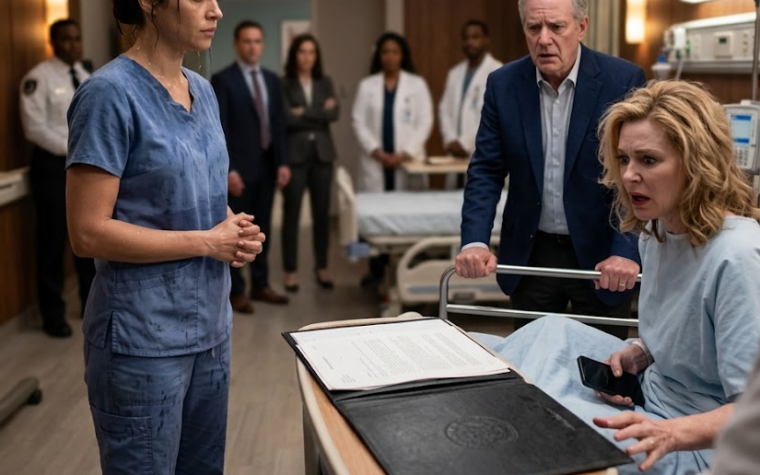
At the hospital, I became a patient in the building where I was accustomed to being useful.
That was harder than I expected.
I kept trying to anticipate what the staff needed until a physician told me gently to stop working and let them care for me.
The burn was serious, but my eye had been spared.
The medical team cleaned and dressed the injury, controlled the pain and documented everything carefully.
Photographs were taken.
The size and shape of the wound were measured.
My damaged scrubs were placed in an evidence bag.
Each clinical detail made the truth harder to erase.
A police officer came to take my full statement after the medication had begun dulling the worst of the pain.
I described the argument Kloe had supposedly had with Jake, her entrance into the laundry room, the iron being taken from my hand, Mom restraining me and Dad’s threat.
The officer asked whether there had been violence before.
I told him about years of intimidation, broken belongings, shoving and threats that had always been dismissed as sibling conflict.
I explained how Kloe’s anger was treated as an emergency while my pain was treated as disobedience.
‘Why didn’t you report it earlier?’ he asked.
It was not accusatory.
Still, the question cut deeply.
‘Because they taught me that nobody would believe me.’
He closed his notebook for a moment.
‘You called tonight.’
‘I did.’
‘That matters.’
Kloe was arrested before midnight.
Mom was detained after admitting that she had grabbed me, though she continued insisting she had done it to prevent a fight.
Dad was removed from the house after officers reviewed the emergency call and the body-camera recordings of his threats.
None of them left together.
For the first time, Kloe cried and my parents could not rush to comfort her.
I remained in the hospital overnight.
My phone filled with calls from numbers I recognized and numbers I did not.
I answered none of them.
Dad left a voicemail telling me to correct the misunderstanding before I destroyed the family.
Mom sent a message saying Kloe could not survive jail and that, as the older sister, I had a duty to protect her.
Another message arrived ten minutes later.
If you continue this, do not come home.
I saved every one.
By morning, the officer assigned to follow up had copies.
The threats did not persuade me to withdraw my statement.
They strengthened the case for a temporary no-contact order.
I was afraid to return to the house, but I had spent years preparing for a future my family did not know about.
Every extra shift, every skipped purchase and every exhausted morning had built a savings account with only my name on it.
A coworker helped me collect a few necessities while officers supervised.
My parents were not permitted to approach me.