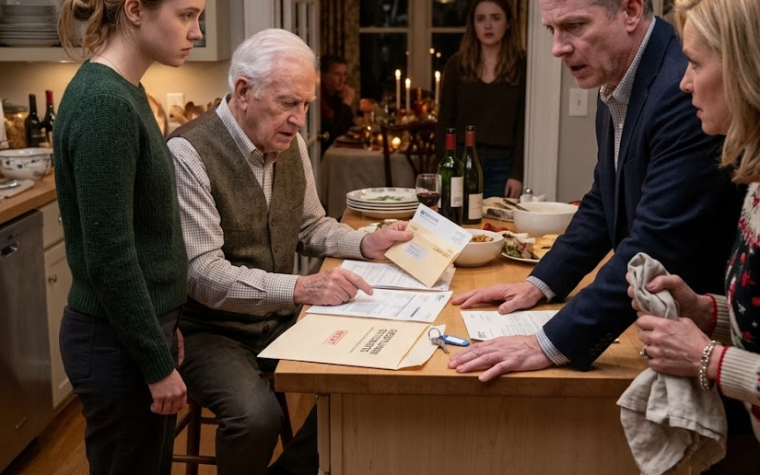
Nobody had an answer for that.
I handed none of them the folder.
I handed them no check.
I did not invite them inside.
My mother left angry.
My father left offended.
Maria left without looking at me.
For several weeks, messages came from relatives.
Some told me I was cruel.
Others admitted they had known my parents favored Maria for years.
A few asked whether the television number was real, which told me exactly why they were calling.
My aunt sent only one message.
“I’m glad you protected yourself.”
I answered her.
Over time, the noise faded.
Maria stayed in medical school, but the arrangement changed.
She and my parents had to deal with the costs without treating my bank account as part of their plan.
Whether that meant loans, stricter spending, or other financing was their responsibility.
I kept competing.
I also kept my design skills because I loved what they represented: the life I had built when nobody handed me a path.
The fifty-million-dollar contract became the headline everyone remembered, but it wasn’t the moment that changed me.
The real change happened months earlier in my parents’ hallway when I picked up my coat while they laughed.
It happened on a station platform when I decided I would rather be alone than repeatedly beg for a place in a room where people enjoyed making me small.
And it happened again at my apartment door when I realized I could love the memory of a little sister holding wildflowers without allowing the adult she became to use me.
The trophy sits in my home now.
Not in the center of the room.
Not under a spotlight.
Beside it, tucked into a drawer, is that old Harbor Ridge transfer confirmation and the receipt from St.
Catherine.
I keep them for a different reason than I once kept Maria’s wildflowers in my memory.
The flowers were proof that I hoped someone else had loved me.
The papers are proof that I had loved generously even when people mistook generosity for weakness.
I don’t regret helping her.
I regret how long I believed help had to be the price of belonging.
My parents once looked at two daughters and decided one had a future and the other didn’t.
They were wrong about me.
But the most important thing is that, eventually, I stopped letting their mistake become my definition.